The Northern Sea Route's 40-Million-Tonne Hinge: Why Russia's Arctic Record Runs on Coastal Cargo and What It Takes to Make Container Transit Real
When Alexei Likhachev (Алексей Лихачев), head of the state corporation Rosatom (Росатом), told the Rossiya 24 (Россия 24) television channel at an international transport and logistics forum that the Northern Sea Route would carry more than 40 million tonnes of cargo in 2026, the figure landed as the next line of a growth story that has been running for years. As Interfax reported on April 2, 2026, Likhachev framed the year in two sentences: traffic is running about 15% above the previous year's record, and he very much hopes the route will set a new record and cross the psychological mark of 40 million tonnes. The previous year's record is a known quantity — 37 million tonnes carried in the Northern Sea Route waters in 2025 — and the institution behind the forecast is not a forecaster at all but the operator: Rosatom has performed the functions of the Northern Sea Route infrastructure development operator, including the nuclear icebreaker fleet, since 2018. What the headline number does not say is what the tonnage consists of. That is where this analysis starts: in the Arctic of Russia, the record is a record of cargo moving inside the route's waters, while the transit that fills conference slides is still, by the route's own documents, a feasibility study.
This piece reads the 2026 forecast as three connected questions rather than one number. First, what the arithmetic of "15% above the record" actually commits the route to, and where the 40-million-tonne mark sits inside it. Second, why a tonnage record can coexist with an absent transit business, and what the composition of today's cargo says about the route's economic role. Third, what the scenarios of 110–150 million tonnes by 2035 and up to 200 million tonnes by 2040 require in annual growth, and which of the route's existing institutions would have to change for those scenarios to stop being scenarios.
37 million tonnes, then 40: the arithmetic of the 2026 record
The starting point is the 2025 total: 37 million tonnes of cargo carried in the Northern Sea Route waters, a record for the route. Against that base, Likhachev's statement that 2026 traffic is running about 15% above the record year translates into roughly 42 to 42.5 million tonnes — and the "psychological" threshold he names, 40 million tonnes, sits below that trajectory rather than above it. In other words, the 40-million-tonne mark is not the forecast; it is the line the forecast expects to cross on the way somewhere higher. To clear it, the route must add at least 3 million tonnes to its best-ever year, an increment of about 8%; to deliver the full 15% it must add more than five.
Two features of that arithmetic deserve attention. The first is its base effect: 15% on 37 million tonnes is a larger absolute increment than the same percentage would have been on any earlier year of the route's modern history, which means the growth claim is getting harder, not easier, to sustain — each record raises the floor under the next one. The second is the wording: Likhachev speaks of traffic "running above" the record during the year, a formulation about the current pace rather than about a signed annual contract book. A pace can be set by a handful of large voyages in a favourable navigation window; converting a pace into a year-end total is exactly the work the icebreaker fleet and the port infrastructure do in the months that remain.
- 2025, the record year: 37 million tonnes carried in the Northern Sea Route waters;
- 2026, the operator's expectation: more than 40 million tonnes, the psychological mark Likhachev expects the route to cross;
- 2026, the pace he describes: about 15% above the record year, i.e. roughly 42 to 42.5 million tonnes if the pace holds;
- The minimum increment to clear 40 million tonnes: about 3 million tonnes, or 8% on the 2025 record;
- The increment implied by the full 15%: more than 5 million tonnes of additional cargo in a single navigation season.
Read this way, the 2026 number is less a promise than a statement about capacity: the operator believes the route's ice and port machinery can absorb 3 to 5 million extra tonnes in one navigation season. Whether that belief is right will be tested not in the forum hall but in the water — in escort schedules, berth windows and the timing of the cargoes themselves.
One operator since 2018: Rosatom, the infrastructure and the nuclear icebreaker fleet
Since 2018, Rosatom has performed the functions of the operator for the development of the Northern Sea Route infrastructure, and that mandate includes the nuclear icebreaker fleet. The combination is unusual and consequential: the entity that forecasts the tonnage is also the entity that builds and maintains the physical conditions under which the tonnage can move. Icebreaker escorts, the organisation of navigation in ice and the development of route infrastructure sit inside one corporate contour, which makes the operator's public numbers something between a corporate plan and a route timetable.
For an analyst, the single-operator model cuts both ways. On the positive side, it removes the classic coordination failure of Arctic shipping: when icebreaker capacity, port development and navigation rules are planned by different hands, each waits for the other, and traffic stays below what any of them could support alone. A single contour can sequence icebreaker availability against cargo commitments. On the negative side, it concentrates the route's execution risk in the same place as its forecasting: if the operator's capacity plan is wrong — an icebreaker in repair, a berth unfinished, a navigation window shorter than assumed — there is no second institution to absorb the error. The 15% pace claim is therefore also a claim about the operator's own machinery.
Why the fleet, not the demand, sets the ceiling
In ordinary shipping markets, tonnage follows demand: ships go where cargo pays. In ice waters the causation partially reverses. The number of voyages that can be escorted through ice in a season is bounded by the icebreaker fleet's availability and by the nuclear fleet's ability to keep the main sections open beyond the natural navigation window. Demand can exist and still not move: a cargo without an escort slot is a cargo that waits. That is why the 2025 record and the 2026 forecast should be read first as statements about fleet and infrastructure utilisation, and only second as statements about trade. The nuclear icebreaker fleet is the asset that converts Arctic geography into a shipping calendar, and every million tonnes above the record is, physically, an escort schedule that was honoured.
A record made inside the waters: why today's tonnage is not transit
Here the composition question becomes unavoidable. The 37 million tonnes of 2025 and the more than 40 million expected in 2026 are cargoes carried in the Northern Sea Route waters. The route's transit function — containers moving between the western and eastern ends of the route as part of a through service — is, according to the operator's own disclosure, not yet an operating business at all: Rosatom is developing a feasibility study for a container line and hub ports in the east and west of the route precisely because that line does not yet exist. A record set before the transit line exists is, by construction, a record of non-transit cargo: shipments whose origin or destination lies along the route — the coastal, cabotage traffic of the Arctic regions and the cargoes of the resource projects that face the route's waters.
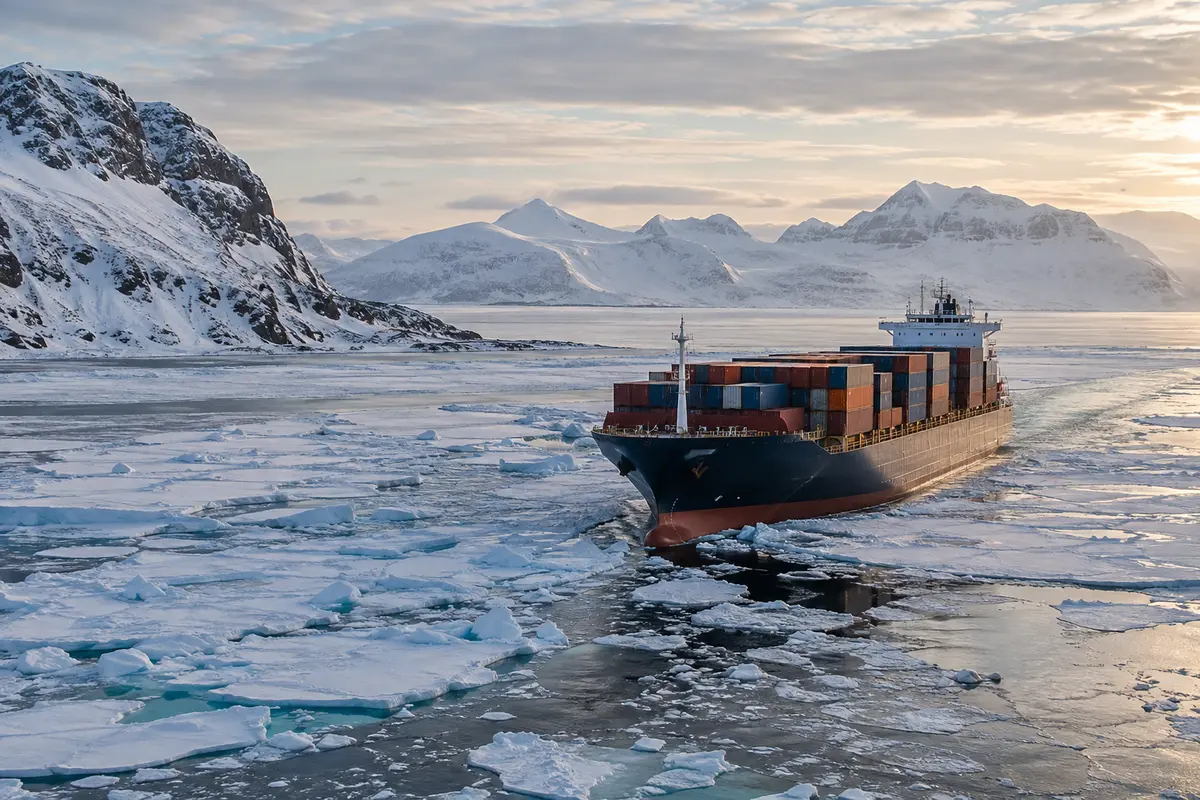
That composition is not a flaw; it is the route's actual economic role today, and in a sense its honest one. A sea lane that serves its own coast is performing a transport function no alternative mode can match at Arctic distances, and the tonnage it carries is real freight with real payers. But it also means that the number the world repeats — "Northern Sea Route tonnage" — currently measures something closer to a regional shipping system than to a competitor of intercontinental routes. The distinction matters for every scenario discussion that follows, because transit tonnes and waters tonnes respond to different drivers: the first to schedule reliability and through-costs between two oceans, the second to the production and consumption plans of the territories along the route.
- Waters traffic: origin or destination inside the route's geography; the cargo serves the Arctic coast and its projects;
- Transit traffic: origin and destination outside the waters, the route used as a through passage between its ends;
- Today's record: waters traffic, because the container line that would carry transit is still at the feasibility-study stage;
- The consequence: the route's headline tonnage can grow for years on coastal and project cargo alone, without a single transit container aboard.
This is the quiet core of the 2026 story. The record is genuine and the growth is genuine, but the growth is being delivered by the part of the route's economics that already works, while the part that captures the imagination — the Arctic as a through route — remains a project under study. Anyone using the 40-million-tonne figure as evidence that container transit via the Arctic has arrived is reading the wrong line of the operator's disclosure.
The feasibility study: a container line with hubs at both ends
The instrument meant to change that composition is the feasibility study Rosatom is developing: a project for a container line and for hub ports at the eastern and western ends of the route, designed to carry transit cargo along the Northern Sea Route. The two-hub architecture is the telling detail. A through container service cannot simply call at existing Arctic berths built for bulk and project cargo; it needs consolidation points where containers are gathered, exchanged and re-stowed — a hub in the west facing the Atlantic directions and a hub in the east facing the Pacific ones. The feasibility study is, in effect, the document that must decide whether such an architecture can be paid for and filled.

What a feasibility study of this kind has to settle is easier to list than to settle. It must define the service: frequency, schedule, transit time between the hubs, and the ice class of the container tonnage that will run it. It must size the hubs: quay length, crane and reefer capacity, storage area, and the connection to the rail and road systems behind each end. It must price the escort: how much nuclear icebreaker time a regular liner service consumes, and what that costs per container. And it must identify the cargo base: which flows, at which seasonality, would choose the Arctic passage often enough to keep a liner schedule honest. Until those answers exist in a document with numbers, the container line remains an intention — and the route's tonnage remains what it is today.
Scenarios to 2035 and 2040: 110–150 and up to 200 million tonnes
The long horizon is where the operator's ambition becomes explicit. In Likhachev's reading, as the Expert outlet conveyed his forecast, cargo traffic on the Northern Sea Route in 2026 may exceed 42 million tonnes, some 14% above 2025; the base scenario puts the route at 110–150 million tonnes by 2035, and the optimistic one at up to 200 million tonnes by 2040. Set beside the 37 million tonnes of 2025, those are multiples rather than increments: the base scenario's lower bound is roughly three times the record year, its upper bound about four times, and the optimistic 2040 figure more than five times.
- 2025 — the record year: 37 million tonnes in the route's waters;
- 2026 — the operator's expectation: above 40 million tonnes, with the pace running about 15% over the record and the Expert-conveyed reading of more than 42 million tonnes, plus 14%;
- 2035 — the base scenario: 110–150 million tonnes, three to four times the 2025 record;
- 2040 — the optimistic scenario: up to 200 million tonnes, more than five times the 2025 record.
The arithmetic of those multiples is the most useful thing about them. From a 2026 level of about 42 million tonnes, reaching 110 million tonnes by 2035 requires compound annual growth of roughly 11% sustained for nine years; reaching 150 million tonnes requires about 15% a year over the same span. Extending to 200 million tonnes by 2040 means keeping double-digit compound growth for a decade and a half. For comparison inside the same dataset: the step from the 2025 record to the 2026 pace — 15% in one year — is exactly the kind of annual rate the base scenario would have to repeat, without a single weak year, for nine consecutive years. Growth of that shape is not a continuation of a trend; it is a change of regime, and a change of regime is precisely what the container line and the hubs are meant to deliver.
What would have to change for container transit to become real
If the scenarios are the destination, the feasibility study is the bridge, and the bridge has known spans. Without prejudging its conclusions, the disclosure itself indicates the components any real transit business would need: the container line as an operating service rather than a project; hub ports at both ends with the capacity to consolidate; an icebreaker and ice-class fleet plan sized for liner regularity rather than for voyage-by-voyage escort; and a cargo base whose flows justify a schedule. Each component is a decision with a price, and the price is why the study exists.
- From study to decision: the feasibility study's numbers converted into an investment decision on the container line and the two hubs;
- From berths to hubs: consolidation capacity at the western and eastern ends, not merely calling points for bulk and project cargo;
- From escorts to schedules: icebreaker capacity planned around a repeating liner timetable, with the escort cost priced per container;
- From projects to flows: a cargo base that chooses the route between its ends, giving transit tonnes a reason to exist alongside waters tonnes;
- From records to structure: tonnage growth that no longer depends on a favourable season alone, but on installed capacity that survives an unfavourable one.
Until those spans are built, the honest reading of every record — 37 million tonnes yesterday, 40 or 42 million tonnes in 2026 — is that the route's coastal and project economy is working well. That is an achievement in its own right at Arctic latitudes, and it is the foundation on which a transit business could one day stand. But it is not yet the transit business, and the distance between the two is measured not in tonnes but in decisions.
Conclusion: a record that points beyond itself
The 2026 forecast is best understood as a hinge. On one side of it stands what the Northern Sea Route already is: a working Arctic shipping system, run by a single operator since 2018, kept open by a nuclear icebreaker fleet, and measured in records — 37 million tonnes in 2025, more than 40 million expected in 2026 at a pace some 15% above the record. On the other side stands what it aspires to become: a through container route with hubs at both ends, carrying 110–150 million tonnes by 2035 and, in the optimistic reading, up to 200 million by 2040. The hinge between the two is the feasibility study now in development, and the composition of today's tonnage — waters traffic rather than transit — is the reason the hinge matters. A record built on coastal cargo proves the route can carry weight; only the line, the hubs and the schedules can prove it can carry trade. The 40-million-tonne mark, when it falls, will therefore be less a finish line than a starting gun: the moment the question stops being whether the Arctic route can set records and starts being whether anyone's containers will choose to cross it.
















Leave a comment