June 2026 nominal wages rose 9.6% y/y to 114,743 rubles after 14.4% in March; real growth halved to 4.5%, and PRIME flags pro-inflationary labour market risks
Overseas remittances from Japan reached a record 1.004 trillion yen, about $6.2 billion, in fiscal 2025, up 11.5% year on year, with Vietnam receiving nearly 30% of the total and Indonesia the second-biggest destination — a flow the Nikkei Asia report attributes to the increase in foreign workers. This analysis reads the record as a mirror of the foreign-workforce expansion: the arithmetic of the flow with its labelled estimates (a prior-year base near 0.90 trillion yen, an increment of about 104 billion yen, an implied rate near 162 yen per dollar, a leading-corridor sum just under 300 billion yen), the stock-versus-flow logic that binds remittances to migrant labour, the wage differential that makes sending rational, and a macro scale that is small in Japanese national accounts yet decisive in receiving households.
The final Rengo tally of July 3, 2026 put Japan's average negotiated wage increase at 5.01% across 5,368 affiliated companies — a third straight year above 5% and the first such streak since 1989–1991 — with base pay up 3.5% against a stated target of at least 3%. This analysis reads the round through its central contradiction: a nominal streak settling slightly below 2025's 5.25% and the March economists' median of about 5.05%, while real wages fell a fourth straight year. It asks what the gap says about price pass-through, why the above-5% outcome was uneven across firm sizes, and why small-firm capacity — not the headline — will decide whether the streak survives a fourth year.
Enterprises reporting missing workers rose from 6% in 2019 to 37% in 2024 while potential labour force fell from 1.6 million to 772 thousand, yet the deficit converted into record hours (38.2 a week), record formalisation (96.2% written contracts) and scarcity-driven wages (43.7 to 89.1 thousand rubles) rather than well-being: labour's share of GDP stays at 44-45% against about 55% in the OECD, and more than a third of households lack a reserve. This analysis traces, on Institute of Economics, TsMAKP, HSE, hh.ru and SuperJob evidence, why a quantitative shortage became a qualitative constraint.
Rengo's final tally put the 2025 shunto average at 5.25% across 5,162 companies and roughly seven million members — the highest since 1991 — yet Takahide Kiuchi's April column for the Nomura Research Institute read the same round as lacking momentum: third-round gains of 5.42% including regular rises and only 3.82% on base pay, small firms at 5.00% against 5.44% at large employers, hikes merely tracking inflation, real wages negative into spring and recovering only around mid-year, and a settlement inadequate to recoup past real-income losses. This analysis weighs the record against the critique and traces what the gap between them means for the Bank of Japan, household consumption and Japan's exit from the lost decades.
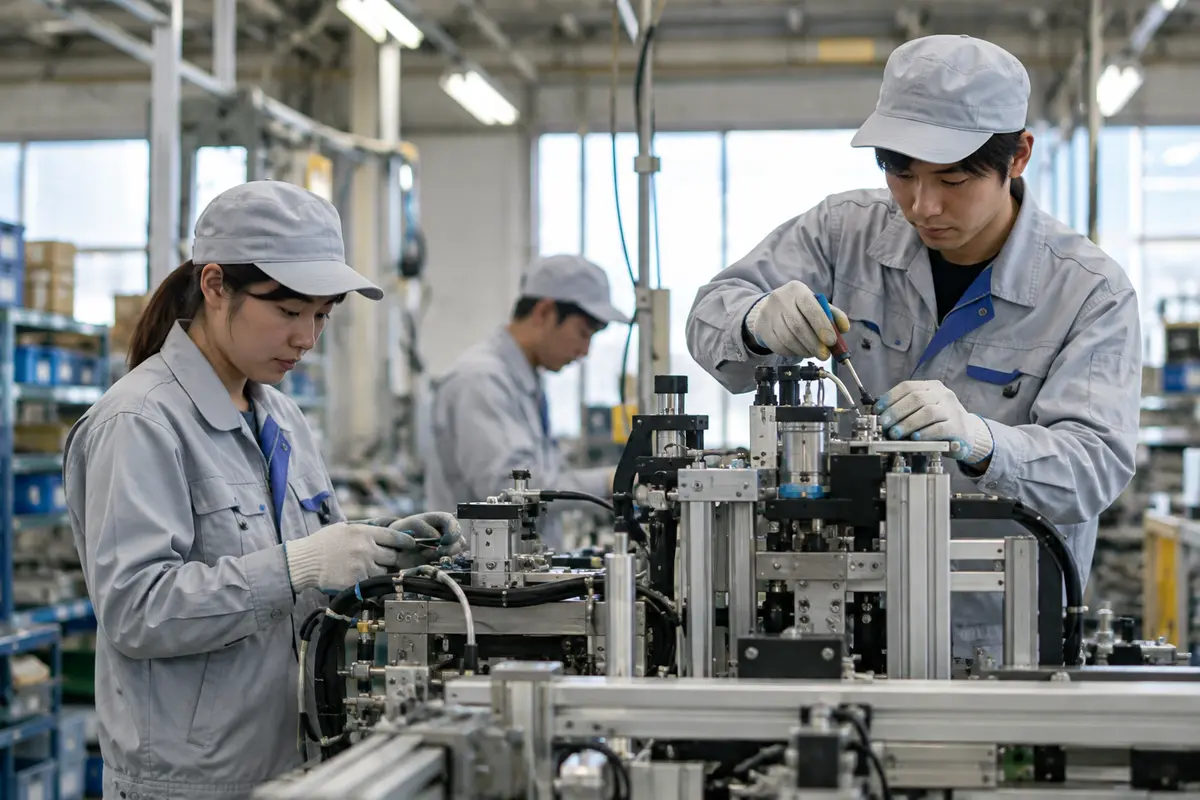
Japan counted a record 2.3 million foreign workers in October 2024, up 12.4% year on year, and a record 342,000 businesses employing at least one of them, up 7.3% — in a labour market with unemployment below 3% for almost four years. This analysis reads the twin records against the structural frame: a working-age population that peaked in 1995, a demand side that never loosens, and the JICA estimate of 6.88 million foreign workers needed by 2040 to meet growth targets. It explains why a record workforce still leaves a gap of about 4.6 million workers, and what the 2040 coordinate implies for intake policy, retention and the employers who must widen and deepen foreign hiring at once.
Unemployment in Russia fell to 3.2% for 2023 and reached a historic minimum of 2.4% in June 2024, holding there in July with 1.9 million unemployed against a labour force of 76.3 million and only 0.4 million registered with the employment service; against Ministry of Labour data of 71.9 million employed (+1.6 million) and rising vacancies on a 3.6% GDP growth path, this analysis of Prime's October 18, 2024 piece traces what stands behind the record — a vanished labour reserve, structural imbalances, forced retention of unskilled employees and Okun's-law pressure — and what it costs companies through recruitment, retention and scarcity-driven wage dynamics.