AI equipment finance and the obligations behind an SPV

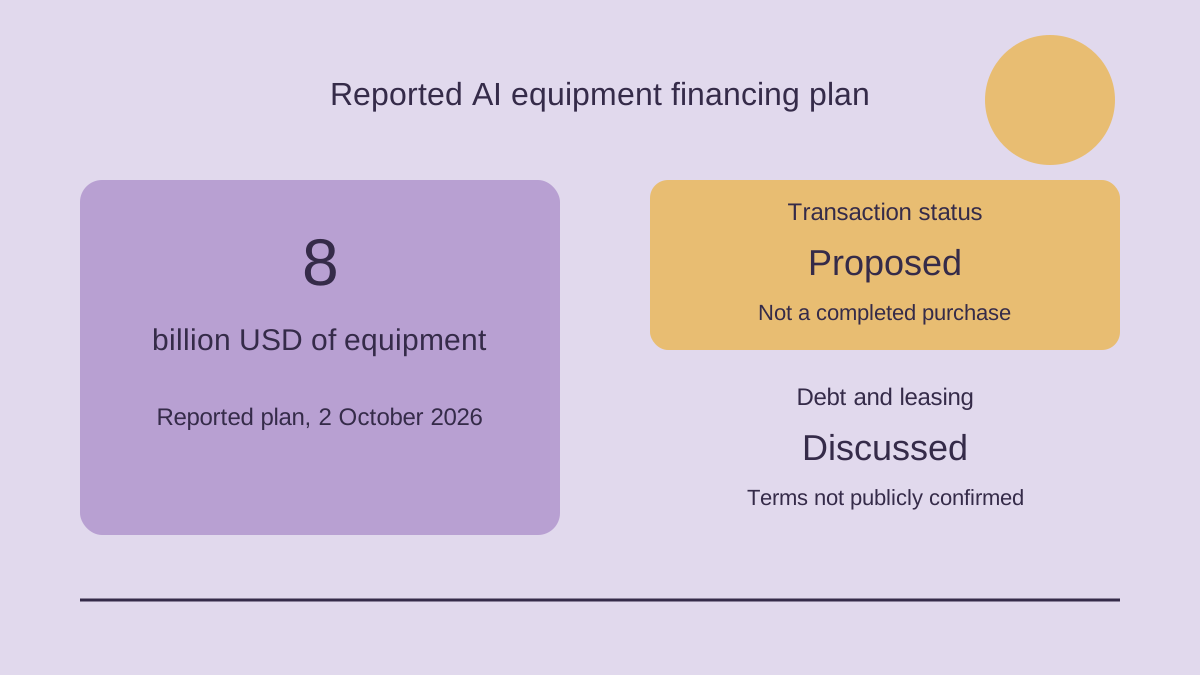
Placing computing equipment in a separate entity changes how its financing can be described, but does not by itself remove the obligations associated with using it. On 2 October, Interfax reported an intended Amazon plan to transfer chips worth about $8 billion to a special-purpose entity and lease them back. The report drew on Financial Times sources. It did not establish that the transaction was complete, debt securities had been issued or a particular accounting treatment had been agreed. The distinction between a proposed structure and a confirmed result matters for business readers.
The Interfax report concerns Nvidia chips being placed in data centres in the United States. Under the reported plan, the entity would seek investors through debt securities. The analysis below examines the organisational logic of such financing rather than its investment appeal. A hypothetical map helps identify the information needed to understand obligations; it does not recommend buying securities, choosing a financing method or drawing a conclusion about a company's future accounts.
The owner and the user have different roles
Equipment can belong to one entity and be used by another. Separating those roles allows the property and the conditions of access to be described independently. It does not mean the user stops depending on the equipment or stops having to pay for it. Understanding the arrangement requires knowing who owns the object, who supports its operation and on what basis the user obtains computing capability. The name of the separate entity does not answer those questions; contracts and responsibilities do.
A useful relationship map begins with these roles rather than a conclusion about balance-sheet relief. It can identify the owner, the user, operating-service providers and potential creditors. Each connection needs a defined subject, such as equipment access, maintenance, payments or rights over security. This map is a way to read future documents, not a description of unpublished terms. It prevents a change in ownership from being mistaken for the disappearance of every obligation associated with the property.
Debt securities describe another relationship
When an entity raises money through debt securities, a relationship arises between the borrower and its creditors. That differs from the relationship between the equipment owner and its user. User payments may matter to the entity's ability to service debt, but an economic connection does not turn every contract into one document. An assessment should show the obligations associated with use separately from obligations to creditors. Otherwise, a reader may transfer a condition from one relationship to another without evidence that it applies.
A meaningful review needs to identify who pays, when the obligation arises and what conditions can affect performance. Mentioning investors does not reveal claim priority, maturity or security. Those questions should remain open until documents become available. Here, they illustrate how to read a financing organisation rather than assess a specific issuance. Reported discussions are not equivalent to money raised. Interest, agreement and execution remain separate stages even when a short news item connects them to a single proposed project.
Property value is different from available cash
An equipment valuation, the amount associated with its proposed transfer and a future financing amount can be different measures. Property value does not automatically demonstrate cash in an account. Raised funds may also arrive at specified times and be used under agreed conditions. A large headline amount should therefore be linked to its subject: property, finance, obligations or payments. Without that link, one figure begins to perform several roles the source did not assign to it, making the arrangement harder to understand.
A proposed structure can be reviewed by recording the equipment list, the basis of its valuation and the events associated with movement of funds. These records may be preliminary. They should not become a claim about liquidity simply because the property is expensive. Total rental payments also require their own terms and period; they cannot be inferred from equipment value in one line. This discipline preserves the units of comparison and shows what information is missing, rather than suggesting that one published amount reveals the entire financing picture.
Computing capability depends on its surroundings
A processor is part of a computing system rather than the entire service. Its use depends on servers, networking, power, cooling and software. Transferring certain property therefore does not automatically describe the transfer of every resource needed for operation. An organisational review should identify where the entity's equipment ends and the environment provided by another party begins. Otherwise, owning chips may be mistaken for independently supplying a complete computing service, a conclusion requiring evidence about the wider system.
An operating map can move from the equipment to its hosting conditions and then to user access. It can identify responsibility for each dependency and the events that might restrict useful operation. This is not a finding about the condition of the named data centres. It shows the boundary of the proposed financing subject. If the arrangement covers particular components, readers need to know which functions lie outside that boundary. Valuation should not silently include premises, power or software capabilities whose contractual status has not been described.
An inventory needs identifiable objects
A total chip count or value is different from identification of individual items. Property management benefits from knowing where an object is located, its condition and the system to which it belongs. These details connect a legal description with physical operation. If a list changes, it should remain possible to understand what changed and why. Otherwise, one equipment label may conceal different states: a delivered component, an installed component and a component actually available for the intended task.
The inventory also helps distinguish replacement from expansion. A new item can add to an existing set or take the place of an item no longer used. For responsibility and tracking, those are different events. Describing the distinction does not establish that the proposed entity already has a particular replacement procedure. It identifies information that would make subsequent reporting verifiable. Clear object identity is needed before a change in property can be related to a change in computing capability across different observations.
Technology renewal requires a separate rule
The computing task and its supporting equipment may change on different schedules. A user might need a different configuration before a financing arrangement ends. Understanding the structure therefore requires information about replacement, upgrades and discontinuing use. Those questions are not answered by the presence of a lease or a separate entity; they need specific terms. Without them, the initial inventory can appear to be an unchanging basis for operation throughout the financing period. Technical suitability and contractual duration should remain distinct.
A review can distinguish equipment that remains suitable, equipment needing a different environment and equipment the user no longer requires. Each case may have different operating consequences. That classification cannot establish future transaction terms or residual value in advance. Those questions require documentation and evidence. It explains why the technology lifecycle should be read alongside the contractual period without treating either as an automatic explanation of the other. An expensive asset is not evidence of suitability for every task throughout any chosen obligation period.
The payment sequence matters
The user may pay on one schedule while the entity services obligations on another. Even when receipts are expected, their timing matters. A difference does not prove a problem, but it needs to be described. Understanding the structure involves identifying the event that creates a user payment, when funds become available to the entity and when its own obligations arise. A general reference to a long-term lease leaves the sequence open. It does not disclose how equipment use connects to financing performance on particular dates.
The sequence can be shown without forecasting returns. Events, responsible parties and dependencies are enough to organise the questions. An unknown date should remain unknown rather than being filled with a convenient assumption. This is an organisational tool, not a recommendation to lend. It distinguishes a proposed economic logic from confirmed movement of money. Until documents and execution evidence are available, a possible payment stream is different from completed financing or fulfilled obligations. Each stage retains its own meaning and needs its own confirmation.
Support from another party must be explicit
A well-known equipment user's name can influence perceptions of an arrangement. A company's reputation, however, is not the text of a guarantee or an obligation to support a separate entity. Where support exists, understanding it requires a specific basis and scope. Where information is unpublished, a familiar participant should not fill the gap. A review can distinguish a participant's name from the document defining its responsibility, especially when a report concerns prospective investor expectations rather than agreed financing terms.
The useful questions concern which obligation a reader assumes and where it is stated. Equipment use, payment obligations and support for the entity's debt can have different subjects. They should be combined only on evidence, not for explanatory convenience. This article reaches no finding about whether particular support exists in the reported plan. It leaves the question open. A large company's participation can be described without turning its reputation into a universal confirmation of future performance, credit quality or the distribution of consequences between parties.
A separate entity does not determine accounting automatically
Creating a legal entity and presenting obligations in financial statements are different questions. Separating property does not establish the final accounting treatment. That assessment requires applicable rules, specific terms and evaluation of relationships between participants. References to balance-sheet relief attributed to sources should therefore remain descriptions of an intended aim or expectation. They should not become a confirmed outcome. The special-purpose label alone does not determine the information that will appear in a company's future financial report.
An organisational analysis can identify that boundary without offering an accounting opinion. A reader can record the reported aim, unknown terms and information needed for a final assessment. This is more precise than saying obligations disappear from accounts merely because property is transferred. It also does not assert the opposite treatment; the specific assessment remains outside the available report. Understanding a financing structure requires distinguishing legal form, economic connections and accounting presentation. Mixing them creates confidence that the evidence does not support.
Operating records support verification
After a possible property transfer, equipment condition continues to change. Hosting, maintenance, replacement and actual use generate information that different participants may need. The structure's description should therefore identify who keeps records and how they connect to the inventory. A periodic report without a clear property link may be convenient but is not a complete operating picture. Verification requires a comparable subject. Readers need to know whether a statement concerns the same equipment and period as another element of the financing description.
In this respect, the organisational structure resembles information transfer between teams. Some specialists see physical equipment, others manage contracts and others read financial reports. Different definitions of the object make comparison difficult. A shared inventory, observation dates and clear roles can reduce that mismatch. This is a possible organising principle rather than a description of the named company's internal process. Its value lies in supporting future assessment with consistent information, instead of several apparently similar figures that actually concern different subjects.
Read the proposed structure by stage
Negotiations demonstrate discussion of interest. Agreed documents describe rights and obligations. Property transfer and receipt of funds concern execution. Subsequent operation generates another set of evidence. These stages can share a purpose without replacing each other in a news report. A proposed plan is useful as an indication of questions that may matter in later reporting. It does not establish every subsequent action as completed. Clear stages make it easier to compare a new announcement with an earlier one and identify what actually changed.
- Separate equipment ownership, its use and relationships with creditors.
- Link each amount to its subject, period and execution stage.
- Read the operating environment, renewal and payment sequence independently.
- Do not infer accounting treatment or debt support from an entity's label.
The reported computing-finance plan makes these distinctions visible without removing the need for evidence. A useful business review moves from an intention to identifiable objects, relationships and completed actions. While terms remain unknown, a question map is more defensible than a confident conclusion about risk transfer or disappearing obligations. It permits discussion of a large amount without giving it several unsupported meanings, preserving the difference between explaining a possible arrangement and claiming that it already operates with specified financial consequences for every participant.



















Leave a comment