Tashkent’s Museums, Mahallas and New Cultural Spaces
The capital's cultural geography includes religious ensembles, applied art collections, neighbourhoods and a former industrial building adapted for contemporary art. These places differ in purpose and in the kinds of material they present. A manuscript collection, a working mahalla and a temporary exhibition require different explanations, even when they can be visited within the same city journey.
The March travel report and subsequent openings
The UzA report of Mar 9, 2026 attributed its travel recommendation to Condé Nast coverage. Its description linked Tashkent with new museum and art initiatives, including the Islamic civilization project and contemporary art residencies in mahallas. The report was written before several later developments and should be read with that date in mind.
A presidential report published on Jun 10, 2026 states that the Center for Islamic Civilization officially opened on Mar 17, 2026. The Centre for Contemporary Arts Tashkent, meanwhile, lists its inaugural exhibition beginning on Sep 6, 2026. These are different institutions with different programmes. The fact that both featured in travel coverage does not give them a shared opening date or a single visitor ticket.
Travel recommendations also differ from operational information. A magazine may select a city or an anticipated museum, while the operator provides its address, current exhibitions and access arrangements. A dated news report can explain why a place attracted attention. It cannot serve indefinitely as the current opening calendar for every institution it mentions.
Religious ensembles and the older city
The Hazrat Imam ensemble belongs to Tashkent's religious and scholarly landscape. The national tourism portal describes monuments including the Kaffal ash-Shashi mausoleum, Barak Khan madrasa and Tillya Sheikh Mosque. Their names identify different structures and functions within a wider ensemble. A mosque is a place of worship, a madrasa is associated with teaching, and a mausoleum commemorates a buried person.
The new Center for Islamic Civilization was built on the territory of this ensemble, according to the presidential description of Mar 17, 2026. It adds a museum, library and research functions in a new building. The centre and the earlier monuments are therefore connected geographically, but their objects, construction histories and visitor arrangements should not be collapsed into one account.
Looking at a religious ensemble involves both architecture and use. Portals, courtyards and domes organize movement and create different kinds of enclosed or open space. A visitor can study those elements without assuming that each building is an unrestricted museum. Worship, scholarly activity, conservation and tourism may occupy adjacent spaces with different schedules.
Tashkent's mahallas add another scale to the city. They are neighbourhood communities, with homes, streets and local social life. A cultural route through them concerns an inhabited environment. The relationship between an old building, its street and the people who use it is different from the relationship between a displayed object and a museum case.
Inside the Center for Islamic Civilization
The Mar 17 presidential report describes a three-storey centre with museum displays, a library and facilities for research and conservation. Its Qur'an Hall presents manuscripts from different historical periods and schools. The report names manuscripts associated with Samanid, Karakhanid, Ghaznavid, Timurid and Shaybanid contexts. The collection therefore concerns both religious texts and the history of manuscript production.
A manuscript is an individual physical object. Its script, paper, binding, decoration and annotations can be studied alongside its text. A printed edition reproduces a work through another production process, while a digital image records selected visual information about a particular copy. These forms are related, but a screen image does not contain every material feature available to a conservator examining the original.
The report also describes restoration and digital preservation facilities. Conservation concerns the condition of an object and the methods used to preserve it. Cataloguing records its identity and relevant information. Digitization creates a digital representation. These activities can support one another while remaining separate tasks with different outputs.
According to the Jun 10 presidential update, the centre had received half a million local and foreign visitors by Jun 1, 2026. That is a reported cumulative figure with a stated cutoff. It should not be used as a current total or confused with the number of objects in the collection. The same update describes conferences, seminars, book presentations and continuing research activity.
A museum visit and a library research visit have different purposes. The exhibition selects material for public interpretation; a library may require registration, a research request or a specific reading arrangement. The presence of a library inside a public cultural building does not imply unrestricted handling of rare books or manuscripts.
Applied arts and the objects of everyday life
The State Museum of Applied Arts provides another route into Uzbek cultural history. The national tourism portal traces its beginnings to a craft exhibition in 1927 and records state museum status in 1977. Its description lists more than seven thousand objects from the nineteenth century onward. That figure belongs to the portal's account of the collection and does not mean all objects are exhibited at once.
Ceramics, jewellery, gold embroidery, clothing, suzanis, carpets, skullcaps, miniatures, decorated wood, porcelain and musical instruments appear among the listed categories. These objects have different materials and functions. A garment is shaped for wear; a carpet organizes a woven surface; a ceramic vessel is formed and fired. The collection allows those differences to be studied in one institution.
Applied art often combines use and decoration. The form of a bowl concerns serving and handling, while its ornament concerns the organization of its surface. Embroidery can mark a garment or furnish a room. A musical instrument is both a made object and a tool for performance. Displaying it in a museum preserves one encounter with it, while playing it involves another.
Details to examine in an applied art display
- The material and technique identified on the label.
- The date or period assigned to the object.
- The place and maker, where they are known.
- The object's intended use and any later change of use.
- Differences between the collected object and a contemporary workshop product.
These details help connect an object with a specific practice. They are also useful when the same broad category appears elsewhere in Uzbekistan. A textile in Tashkent's collection may belong to a regional tradition beyond the capital, and its label is the relevant starting point for that geographical connection.
A tram-era building adapted for contemporary art
The Centre for Contemporary Arts Tashkent describes its home as a revitalized industrial building dating to 1912, originally a diesel station and tram depot. Studio KO adapted the structure for its new cultural use. This gives the centre a different architectural starting point from a madrasa or a purpose-built museum.
An industrial building is organized around work, equipment and movement. Its conversion involves another programme: exhibition, research, public gathering and the services needed to support them. The original date describes the older structure; it is not the founding date of the contemporary arts institution. Keeping those dates separate allows the building's history and the centre's programme to be read together.
The operator lists HIKMAH as its inaugural exhibition, running from Sep 6, 2026 to Jan 31, 2027. It also describes a wider programme of research and community engagement. An exhibition has a defined title and duration, while the institution can continue to operate with a changing programme. A visit during one exhibition period therefore differs from a visit after that exhibition closes.
The centre's programme includes work at other venues. Its listing for Vyacheslav Akhunov's Instruments of the Mind identifies Palazzo Franchetti in Venice, as a collateral project of the 2026 Venice Biennale. Its Benchellal exhibition is listed at the State Museum of History of Uzbekistan. Neither listing should be mistaken for an exhibition necessarily located inside the centre's main Tashkent building.
Residencies, mahallas and cultural production
The March UzA report referred to artist residencies in mahallas. A residency gives an artist time and a setting in which to work; it is different from a public exhibition with fixed opening hours. A project can involve a neighbourhood without making every residence or workspace in that neighbourhood open to visitors.
Residency work may develop through research, discussion, making or collaboration. Its public form could later be an object, performance, publication or exhibition. The specific project determines which of those forms applies. A general announcement of a residency programme is not enough to assign a particular artwork to every participating location.
The contemporary arts centre describes research and community engagement as parts of its institutional role. Those terms can encompass activity beyond the display of finished artworks. A library supports reading, a workshop supports making, and a discussion brings participants together at a scheduled time. These components introduce different rhythms into a cultural building.
Local neighbourhoods also contain cultural practices outside a formal residency programme. Craft, food preparation, social gatherings and domestic architecture have their own contexts. A visitor can learn about those contexts through an arranged programme while recognizing that the people involved continue their ordinary work and household activities beyond the visit.
For cultural travel, the distinction between a public event and a private workspace is concrete. The operator's programme identifies an event that can be attended. A residency announcement identifies a period of work. Access to a workshop or a residence depends on the arrangements of the people who use it, rather than on its appearance in a citywide cultural story.
The March centre report gives the library an area of 3,105 square metres and a capacity for 310 users. It lists handwritten and lithographic sources alongside printed and electronic publications. These categories describe different forms of reading material, while the user capacity concerns the space available for consultation. Neither figure is a count of museum visitors.
The library description also identifies a department devoted to twenty-two Jadid enlighteners, with portraits and works by or about them. This introduces the history of education and intellectual reform alongside earlier manuscript traditions. A displayed portrait supplies an image of a person; the associated books provide another form of access to their work and later interpretation.
These components broaden the museum-centred city route into a history of reading, teaching and preservation. They also remain institutional facilities with their own access requirements, rather than additional rooms automatically included in every guided exhibition visit.
Connecting collections, neighbourhoods and transport
Tashkent's metro belongs to another layer of the capital's built environment. The first line opened in 1977, and later lines and extensions expanded the system. Station interiors can be studied as designed public spaces, with their own materials, lighting and architectural forms. They remain transport facilities used in daily travel.
A museum route can therefore include several kinds of urban experience: the streets around a religious ensemble, the rooms of an applied art collection, a repurposed industrial building and the movement between them. The transfer is part of the journey, but it does not make every station an exhibition venue or every neighbourhood a programmed cultural attraction.
Each institution supplies a different source of information. Museum labels identify objects; a historical description identifies monuments; an exhibition programme identifies temporary works and dates; a transport operator supplies route and service information. Using the appropriate source for each part avoids borrowing a collection's date for a building or treating an old city description as a current opening notice.
The capital also provides a geographical link to journeys beyond it. Travellers may continue to Samarkand and Bukhara for architectural ensembles, or to the Fergana Valley for workshops. Tashkent's collections can introduce materials and historical periods that appear again along those routes. The later encounter, however, takes place at another site with its own local history and custodians.
The Mar 9 travel report brought attention to a changing cultural programme. The later opening records and operator listings give that programme more precise dates and locations. Together they describe a capital where religious heritage, collected craft objects, industrial architecture and contemporary production can be explored as distinct but connected parts of a city visit.

Tashkent is a starting point for Uzbekistan museum and heritage itineraries, with collections and cultural spaces that belong to several different chapters of the capital's history. The capital contains religious ensembles, manuscript collections, applied arts and contemporary art spaces. The Center for Islamic Civilization opened in March 2026, while the Centre for Contemporary Arts Tashkent’s inaugural exhibition began in September. Each institution has its own building and programme.
The capital's cultural geography includes religious ensembles, applied art collections, neighbourhoods and a former industrial building adapted for contemporary art. These places differ in purpose and in the kinds of material they present. A manuscript collection, a working mahalla and a temporary exhibition require different explanations, even when they can be visited within the same city journey.
The March travel report and subsequent openings
Tashkent featured in Condé Nast travel coverage highlighted by UzA on Mar 9, 2026. New museum initiatives and contemporary art residencies in mahallas were among the subjects receiving attention. The Center for Islamic Civilization and Centre for Contemporary Arts Tashkent have separate buildings, collections and programmes. Their later opening dates belong to different stages of the capital’s developing cultural calendar.
The Center for Islamic Civilization officially opened on Mar 17, 2026. The Centre for Contemporary Arts Tashkent’s inaugural exhibition began on Sep 6, 2026. The first institution combines museum, library and research functions; the second presents contemporary artistic work. Their programmes occupy different venues and periods. A visit to one therefore involves its own exhibitions and arrangements alongside any separate visit to the other.
The capital’s new cultural calendar includes the March opening of the Center for Islamic Civilization and the September inaugural exhibition at the Centre for Contemporary Arts. Earlier travel coverage introduced these projects to an international audience. Their public programmes now occupy separate venues within Tashkent, alongside older monuments and the State Museum of Applied Arts with its own institutional history.
Religious ensembles and the older city
The Hazrat Imam ensemble includes the Kaffal ash-Shashi mausoleum, Barak Khan madrasa and Tillya Sheikh Mosque. Each structure has its own function within Tashkent’s religious and scholarly landscape. A mausoleum commemorates a burial, a madrasa is associated with teaching, and a mosque provides a place of worship. Courtyards and adjoining buildings connect these uses within the broader ensemble.
The new Center for Islamic Civilization was built on the territory of the Hazrat Imam ensemble. Its museum, library and research spaces occupy a new building alongside the earlier religious monuments. The centre adds collections and scholarly facilities to the geographical setting. The older mausoleum, madrasa and mosque retain their individual construction histories and functions within that part of Tashkent.
Looking at a religious ensemble involves both architecture and use. Portals, courtyards and domes organize movement and create different kinds of enclosed or open space. A visitor can study those elements without assuming that each building is an unrestricted museum. Worship, scholarly activity, conservation and tourism may occupy adjacent spaces with different schedules.
Tashkent's mahallas add another scale to the city. They are neighbourhood communities, with homes, streets and local social life. A cultural route through them concerns an inhabited environment. The relationship between an old building, its street and the people who use it is different from the relationship between a displayed object and a museum case.
Inside the Center for Islamic Civilization
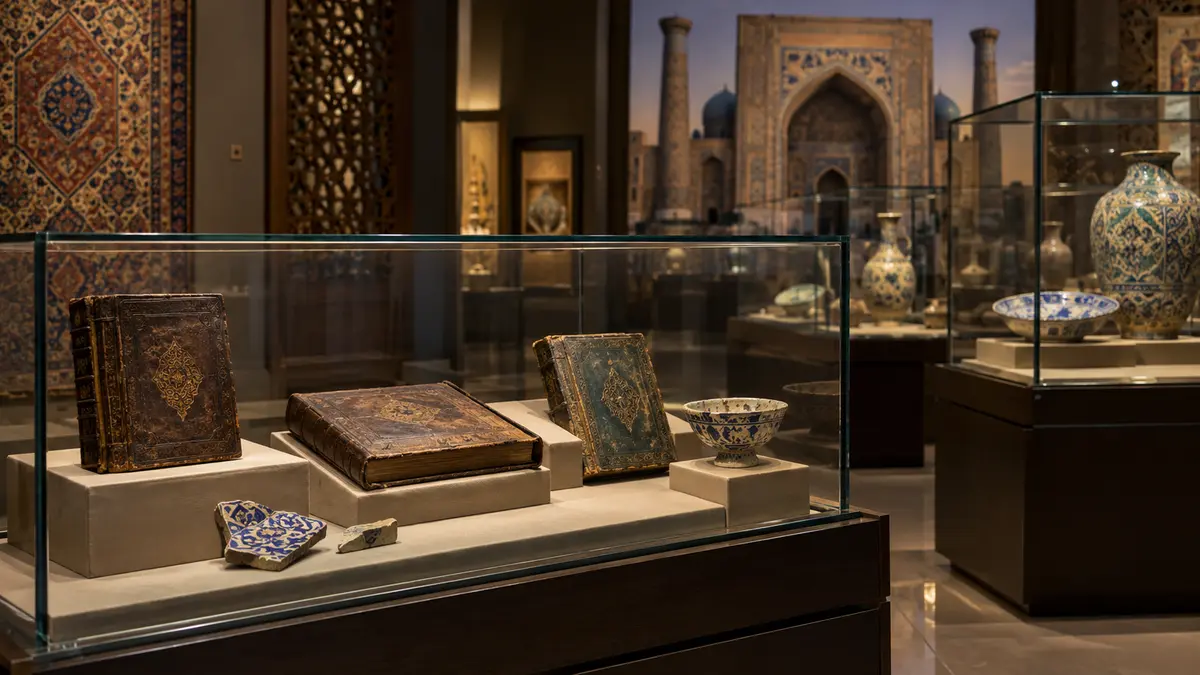
The three-storey Center for Islamic Civilization contains museum displays, a library and facilities for research and conservation. Its Qur’an Hall presents manuscripts from different historical periods and schools, including Samanid, Karakhanid, Ghaznavid, Timurid and Shaybanid contexts. These collections introduce the history of manuscript production alongside the texts themselves. Individual copies have their own script, paper, binding, decoration and material condition.
A manuscript is an individual physical object. Its script, paper, binding, decoration and annotations can be studied alongside its text. A printed edition reproduces a work through another production process, while a digital image records selected visual information about a particular copy. These forms are related, but a screen image does not contain every material feature available to a conservator examining the original.
The centre has restoration and digital preservation facilities. Conservation addresses the material condition of manuscripts and other objects. Cataloguing records identity and descriptive information, while digitisation produces images and other digital representations. A manuscript can pass through all three activities, with its physical conservation, catalogue entry and digital copy supplying different forms of work within the institution.
By Jun 1, 2026, the centre had received half a million local and foreign visitors, according to the presidential update published on Jun 10. That cumulative attendance figure has a defined cutoff. Conferences, seminars, book presentations and continuing research also formed part of the centre’s activity. Museum visits, scholarly events and library work use different parts of the institution’s programme and facilities.
A museum visit and a library research visit have different purposes. The exhibition selects material for public interpretation; a library may require registration, a research request or a specific reading arrangement. The presence of a library inside a public cultural building does not imply unrestricted handling of rare books or manuscripts.
Applied arts and the objects of everyday life
The State Museum of Applied Arts began with a craft exhibition in 1927 and acquired state museum status in 1977. Its collection contains more than seven thousand objects from the nineteenth century onward. Exhibits cover materials and techniques associated with everyday objects and decorative work. The collection total includes objects held by the museum beyond those selected for a particular public display.
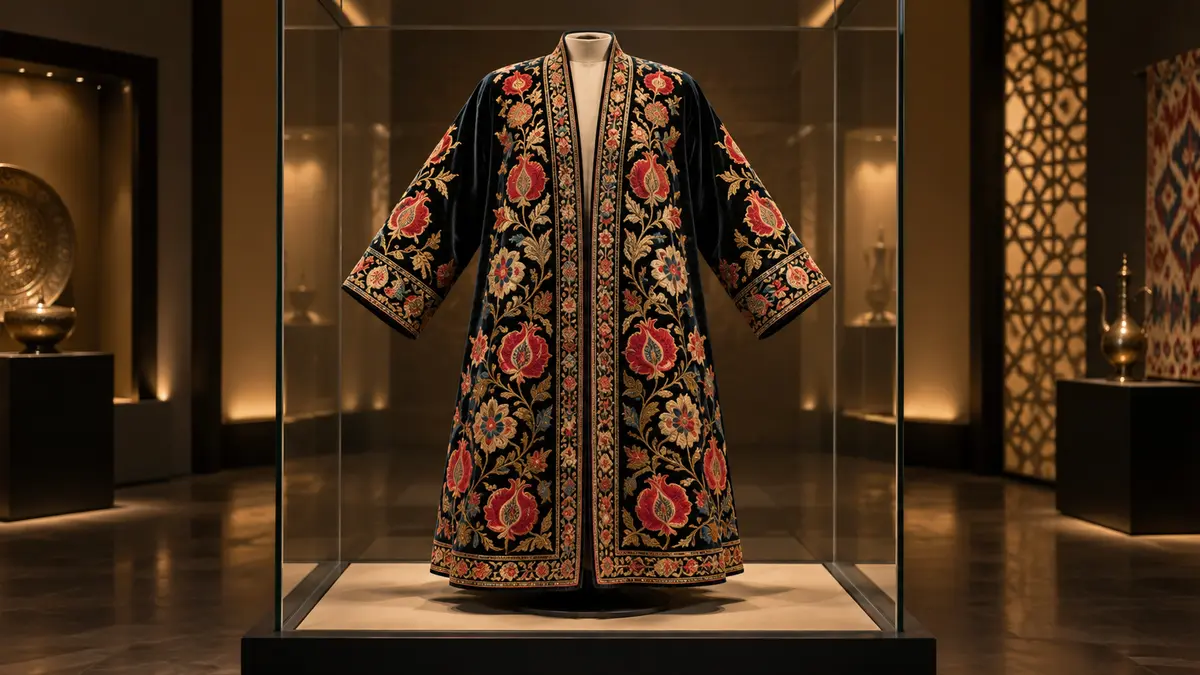
Ceramics, jewellery, gold embroidery, clothing, suzanis, carpets, skullcaps, miniatures, decorated wood, porcelain and musical instruments appear among the listed categories. These objects have different materials and functions. A garment is shaped for wear; a carpet organizes a woven surface; a ceramic vessel is formed and fired. The collection allows those differences to be studied in one institution.
Applied art often combines use and decoration. The form of a bowl concerns serving and handling, while its ornament concerns the organization of its surface. Embroidery can mark a garment or furnish a room. A musical instrument is both a made object and a tool for performance. Displaying it in a museum preserves one encounter with it, while playing it involves another.
Details to examine in an applied art display
- The material and technique identified on the label.
- The date or period assigned to the object.
- The place and maker, where they are known.
- The object's intended use and any later change of use.
- Differences between the collected object and a contemporary workshop product.
These details help connect an object with a specific practice. They are also useful when the same broad category appears elsewhere in Uzbekistan. A textile in Tashkent's collection may belong to a regional tradition beyond the capital, and its label is the relevant starting point for that geographical connection.
A tram-era building adapted for contemporary art
The Centre for Contemporary Arts Tashkent describes its home as a revitalized industrial building dating to 1912, originally a diesel station and tram depot. Studio KO adapted the structure for its new cultural use. This gives the centre a different architectural starting point from a madrasa or a purpose-built museum.
An industrial building is organized around work, equipment and movement. Its conversion involves another programme: exhibition, research, public gathering and the services needed to support them. The original date describes the older structure; it is not the founding date of the contemporary arts institution. Keeping those dates separate allows the building's history and the centre's programme to be read together.
The operator lists HIKMAH as its inaugural exhibition, running from Sep 6, 2026 to Jan 31, 2027. It also describes a wider programme of research and community engagement. An exhibition has a defined title and duration, while the institution can continue to operate with a changing programme. A visit during one exhibition period therefore differs from a visit after that exhibition closes.
Vyacheslav Akhunov’s Instruments of the Mind was listed at Palazzo Franchetti in Venice as a collateral project of the 2026 Venice Biennale. The Benchellal exhibition was listed at the State Museum of History of Uzbekistan. These venues extend the contemporary arts programme beyond the centre’s main Tashkent building. Each exhibition has its own location and public presentation period.
Residencies, mahallas and cultural production
Artist residencies in Tashkent’s mahallas provide time and working space within neighbourhood settings. A residency can involve research, making and exchange with people in the community. An exhibition presents work to a public audience on its own dates. Some artistic activity therefore takes place in studios and workspaces before a public presentation, with access arranged according to the project and venue.
Residency work may develop through research, discussion, making or collaboration. Its public form could later be an object, performance, publication or exhibition. The specific project determines which of those forms applies. A general announcement of a residency programme is not enough to assign a particular artwork to every participating location.
The contemporary arts centre describes research and community engagement as parts of its institutional role. Those terms can encompass activity beyond the display of finished artworks. A library supports reading, a workshop supports making, and a discussion brings participants together at a scheduled time. These components introduce different rhythms into a cultural building.
Local neighbourhoods also contain cultural practices outside a formal residency programme. Craft, food preparation, social gatherings and domestic architecture have their own contexts. A visitor can learn about those contexts through an arranged programme while recognizing that the people involved continue their ordinary work and household activities beyond the visit.
Residencies supply time and space for artists to work, while public exhibitions present selected work to audiences. A neighbourhood project can involve studios, research and exchange with residents. The public encounter takes place through the activity arranged for visitors, such as an exhibition or event. Workspaces remain part of the making process, with access determined by their users and programme.
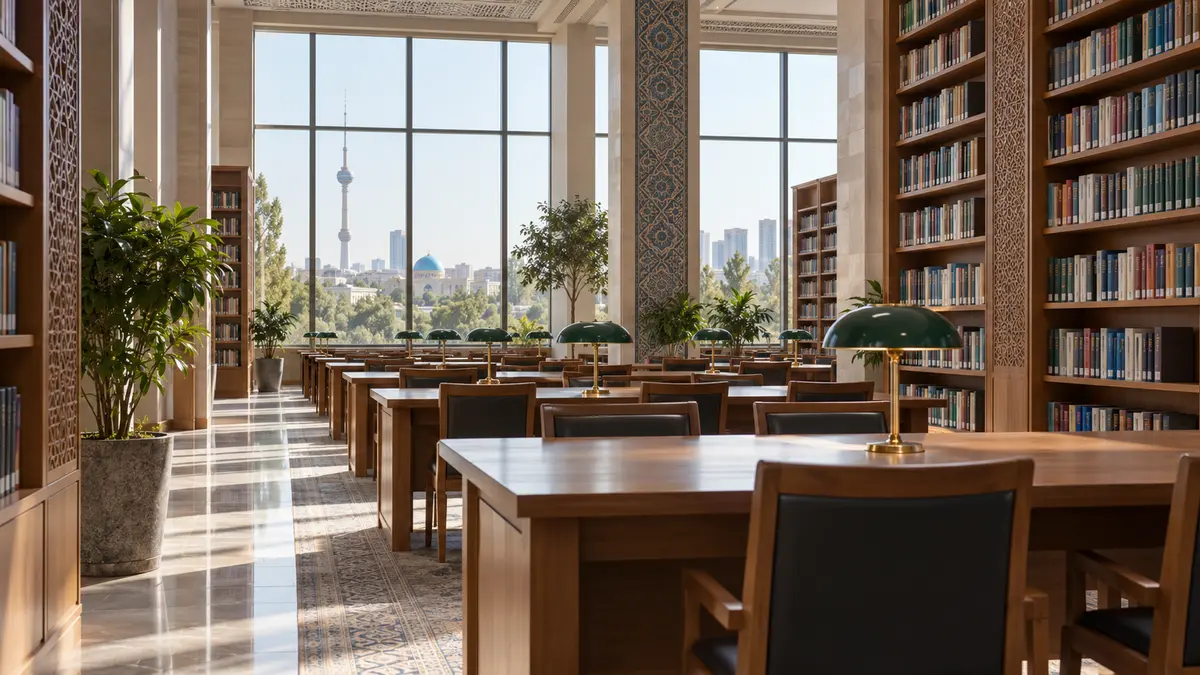
The Center for Islamic Civilization’s library covers 3,105 square metres and has capacity for 310 users. It holds handwritten and lithographic sources alongside printed and electronic publications. These materials have different production methods and formats, while reading spaces provide room for consultation. The floor area and user capacity concern the library’s facilities; museum attendance belongs to the centre’s wider visitor programme.
A library department is devoted to twenty-two Jadid enlighteners, with portraits and works by or about them. It introduces educational and intellectual reform alongside the centre’s earlier manuscript traditions. Portraits identify the people represented, while their writings and later studies provide material for reading. The department brings those different forms of evidence into a named part of the library’s collection.
These components broaden the museum-centred city route into a history of reading, teaching and preservation. They also remain institutional facilities with their own access requirements, rather than additional rooms automatically included in every guided exhibition visit.
Connecting collections, neighbourhoods and transport
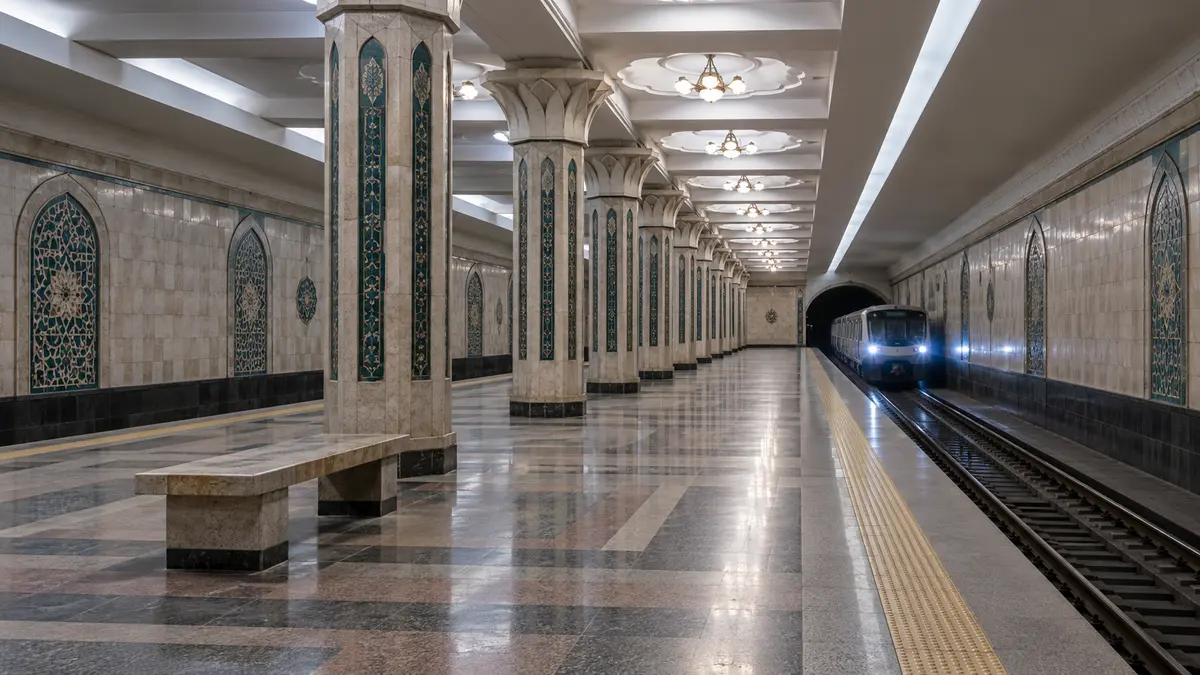
Tashkent's metro belongs to another layer of the capital's built environment. The first line opened in 1977, and later lines and extensions expanded the system. Station interiors can be studied as designed public spaces, with their own materials, lighting and architectural forms. They remain transport facilities used in daily travel.
A Tashkent museum route moves between several kinds of urban space. Streets around Hazrat Imam connect religious monuments with the new centre; the applied arts collection occupies another institutional setting; the contemporary arts centre uses a repurposed industrial building. Travel between those venues adds stations, roads and walking to the visit, alongside time spent in galleries and library or museum spaces.
Museum objects, monuments, exhibitions and neighbourhood projects occupy different spaces across Tashkent. A collection can contain manuscripts, textiles or metalwork; an exhibition can present a temporary selection of contemporary pieces; a historic ensemble includes buildings with continuing religious uses. The journey between them adds transport and walking to the visit. Individual venues have their own entrance points and public programmes.
The capital also provides a geographical link to journeys beyond it. Travellers may continue to Samarkand and Bukhara for architectural ensembles, or to the Fergana Valley for workshops. Tashkent's collections can introduce materials and historical periods that appear again along those routes. The later encounter, however, takes place at another site with its own local history and custodians.
Tashkent’s cultural destinations include the religious monuments at Hazrat Imam, manuscript and library collections, the State Museum of Applied Arts and a tram-era building adapted for contemporary art. Their histories and programmes span different periods. ABA Travel’s museum and heritage routes place the capital alongside other Uzbek cities, while a stay in Tashkent provides time for visits to these separate institutions.