Russia's 20 Million Tonne Grain Export Quota Takes Effect on February 15, 2026
A grain export quota of 20 million tonnes came into effect in Russia on February 15, 2026, Interfax reported on February 16, 2026. The restriction was introduced by a government resolution signed in December 2025 and will remain in force until June 30, 2026.
What the quota covers
The quota applies to grain shipped to destinations outside the Eurasian Economic Union (EAEU). The resolution sets a single volume ceiling for the February 15 – June 30, 2026 window and separately fixes a zero limit for rye, meaning that rye exports under the quota regime are not permitted at all during the period.
- wheat, meslin, barley and corn exported outside the EAEU;
- a zero quota for rye;
- the validity period — from February 15 to June 30, 2026;
- the legal basis — a government resolution signed in December 2025.
The mechanism therefore does not ban exports but caps them: within the 20 million tonne ceiling, shipments of the four named crops to non-EAEU destinations remain possible, while rye is excluded from export entirely for the duration of the quota.
Distribution among exporters
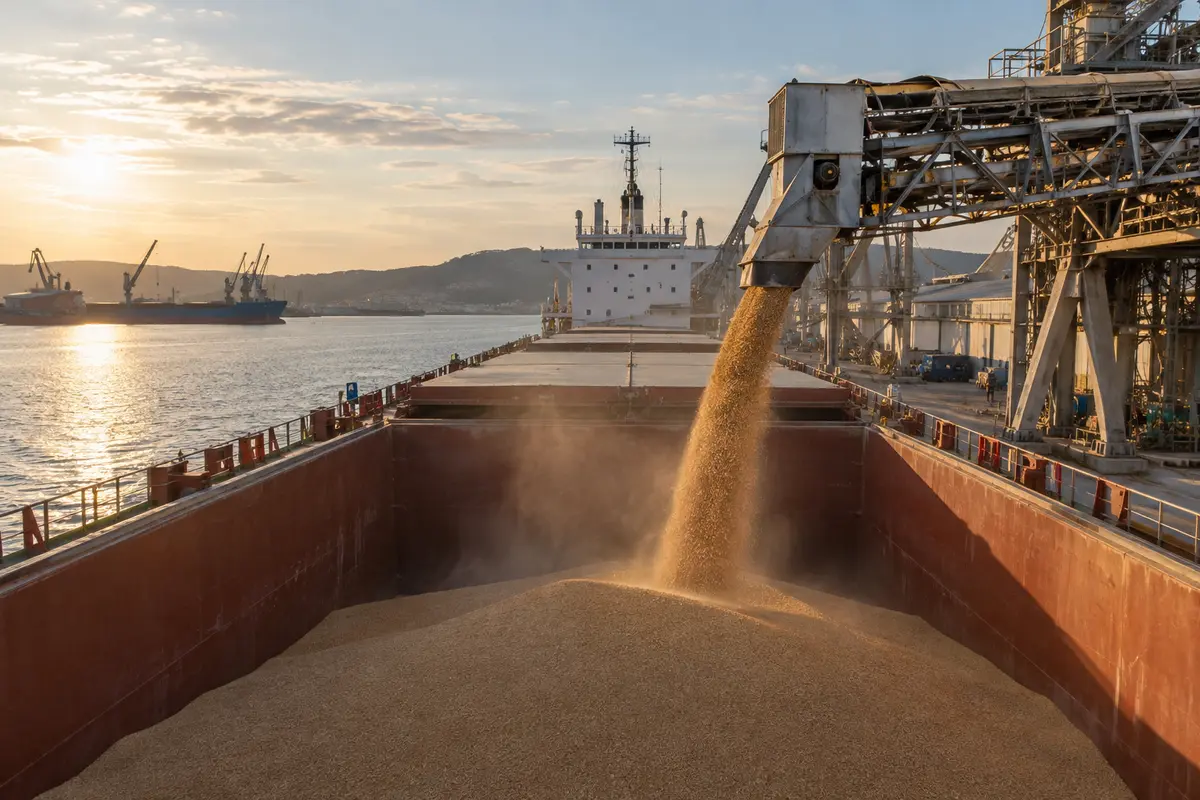
The Agriculture Ministry distributed most of the 20 million tonne quota among 213 companies. In practice this means that the bulk of the permitted volume was allocated in advance to a defined circle of market participants, rather than being drawn down on a first-come basis by anyone wishing to ship grain abroad.
The distribution decision complements the resolution itself: the government sets the total ceiling and the product perimeter, while the ministry handles the allocation of the volume among exporters. For the market, the list of 213 companies defines who holds the quota rights for the February 15 – June 30, 2026 season.

How the quota is split since 2024
Since 2024 the quota has been divided into two parts with different allocation logic:
- the main part — 90% of the quota, distributed on the historical principle, that is, with reference to participants' past export volumes;
- the additional part — 10% of the total quota, plus amounts exempt from the reduction factor, plus quota amounts that were declined.
The two-part design separates a predictable, history-based core from a smaller flexible pool. The main part gives established exporters continuity, while the additional part absorbs volumes that fall outside the reduction factor and amounts released by companies that declined their allocations.
Quota history: 2020 to 2025
Export quotas have been applied since 2020, and their size has varied widely from season to season depending on the harvest and the market situation:
- 2020 — 7 million tonnes, for the period from April 1 to June 30, 2020;
- 2021 — 17.5 million tonnes, for the period from February 15 to June 30, 2021;
- 2022 — 11 million tonnes, including 8 million tonnes of wheat;
- 2023 — 25.5 million tonnes;
- 2024 — 29 million tonnes;
- 2025 — 10.6 million tonnes.
Since the end of 2021 the quota window has been standardized as February 15 to June 30 each year, and the 2026 quota follows the same calendar. Against this series, the current 20 million tonnes sits between the tight 10.6 million tonnes of 2025 and the record 29 million tonnes of 2024.
Conclusion
The 20 million tonne quota in force from February 15 to June 30, 2026 continues a mechanism that Russia has applied since 2020: a temporary ceiling on grain exports outside the EAEU, with rye excluded at zero and most of the volume pre-allocated by the Agriculture Ministry among 213 companies. The two-part structure introduced in 2024 — a 90% historical-principle core plus an additional pool — remains in place, and the current figure once again shows how flexibly the ceiling moves from year to year with the harvest and the market.




















Leave a comment