The First Decline in Five Years: Russia's 2025 Capital Investment Drop and the Shift From Expanding Capacity to Maintaining It
On March 13, 2026, Kommersant (Коммерсантъ) published an analysis by Artem Chugunov (Артем Чугунов) built around a figure that rewrites the familiar story of the investment boom of recent years: according to Rosstat (Росстат), fixed capital investment in Russia fell by 2.3% in real terms in 2025, the first annual decline in five years. As the Kommersant analysis shows, behind the 2025 minus sign stands not a statistical accident but a change of regime: the economy of Russia was moving from expanding production capacity to maintaining it, and that shift is visible at once in the quarterly trajectory, in the sectoral structure of investment and in the answers companies give to the regulator's surveys. This analysis follows every line of that picture, from the annual minus to the investment plans of February 2026, and shows why the decline in capital investment should be read as a structural signal rather than as a statistical fluke.
The first minus in five years
The annual Rosstat figure looks modest against the backdrop of earlier years, but it is precisely the contrast with them that turns it into an event. For three years in a row, fixed capital investment grew at rates that would count as high for any large mature economy: plus 6.7% in 2022, plus 9.8% in 2023 and plus 8.4% in 2024. On such a trajectory, the -2.3% of 2025 means not a slowdown of growth but a reversal of its sign — the first annual decline in five years, ending an unbroken upward series.
- 2022: plus 6.7% in real terms;
- 2023: plus 9.8%;
- 2024: plus 8.4%;
- 2025: minus 2.3% — the first annual decline in five years.
Even more telling is the quarterly trajectory, because it shows not a point but a direction of travel. The first quarter of 2025 still carried the inertia of the investment boom, growing 6.5% year on year. In the second quarter growth turned into a minus of 1%, in the third the decline deepened to 4.3% and in the fourth to 5.3%. In other words, each successive quarter of the year was worse than the one before it, and the economy entered 2026 with an accelerating rather than fading minus.
- first quarter of 2025: plus 6.5% year on year;
- second quarter of 2025: minus 1%;
- third quarter of 2025: minus 4.3%;
- fourth quarter of 2025: minus 5.3%.
This shape of decline — a gradual deepening from quarter to quarter — differs both from a cliff-edge crisis collapse and from a soft mid-cycle pause. It is characteristic of situations in which the very source of growth runs out: projects launched on the wave of earlier years are completed and drop out of the commissioning statistics, while new starts prove insufficient to offset the loss of the old ones. It is this mechanism that the remaining lines of the annual analysis allow us to trace.
The forecast that did not come true
The scale of the surprise is visible in the gap between the outcome and expectations. The Interfax (Интерфакс) consensus collected at the end of December assumed growth of 0.7% in fixed capital investment for 2025 as a whole; the Economy Ministry (Минэкономики) in September 2025 expected plus 1.7%. The actual minus 2.3% implies a divergence from the consensus of roughly three percentage points, and from the ministry's September estimate of about four. For an indicator that normally moves smoothly and inertially, this is a forecasting error of a different order than the usual tenths of a percent.
Equally telling is who exactly was wrong, and in which direction. It was not a handful of pessimists but every observer at once: both the market consensus of late December and the official forecast of September assumed that growth would continue, however moderate. That means that at the end of 2025 analysts underestimated the speed with which tight monetary policy and the cooling of domestic demand were eating into investment activity. A forecasting error of this magnitude is not a technical detail of reporting; it is a sign that the economy had switched regimes, and that the models and surveys of year-end had not yet caught up with the switch.
Official readings: the price of disinflation and demand near the peak
The first official explanation came from Economy Minister Maxim Reshetnikov (Максим Решетников) in February 2026 at a State Duma (Госдума) committee meeting: he called the slowdown in investment activity the "natural price of bringing inflation down" under tight monetary policy. In this logic the decline in capital investment is not an accident but a bill presented by disinflation: expensive money cools demand, and with it the need of companies for new capacity.
The second reading belongs to the Bank of Russia (ЦБ). The regulator points to the cooling of domestic demand as the cause of the decline, and at the same time stresses that the level of capital investment "remained close to the maximum of recent years". These two statements must be held together. The cooling of demand explains the direction of movement; the proximity to the maximum explains its scale: the decline proceeds from a high base, and even after minus 2.3% the economy remains at one of the peak levels of investment activity of recent years.
Joined together, the two official readings set the frame for everything that follows. If the decline is the price of disinflation under tight monetary policy, then its depth and duration depend on the path of the policy rate and of domestic demand. If, on the other hand, the level of investment remains close to the maximum, then what is happening is not the destruction of the investment process but its rearrangement. It is rearrangement, not collapse, that the structural data of the year show.
The structure of the decline: who cut and who kept investing
The decline of 2025 was not universal. In the Bank of Russia's assessment, capital investment fell most noticeably in transport, construction and agriculture — the sectors most sensitive to the cost of borrowed money and to the state of final demand. Transport and construction live on long credit leverage and deferred demand; agriculture lives on the seasonal cycle and on margins eaten by costs. For all three, the expensive monetary policy of 2025 acted as a direct brake on investment programmes.
Against this background, manufacturing grew by 11% year on year. But here too the source of growth is specific: the Bank of Russia links it to state demand and import substitution. In other words, the manufacturing plus is not a market wave of private investment projects but an order formed and financed predominantly by the state. The divergence between the minus in transport, construction and agriculture and the plus in manufacturing describes an economy in which investment demand is concentrating ever more visibly where the budget supports it.
- the most noticeable decline in capital investment — in transport, construction and agriculture;
- manufacturing grew 11% year on year on state demand and import substitution;
- the share of investment in residential buildings and intellectual property assets rose;
- the share of machinery and equipment in the investment structure fell.
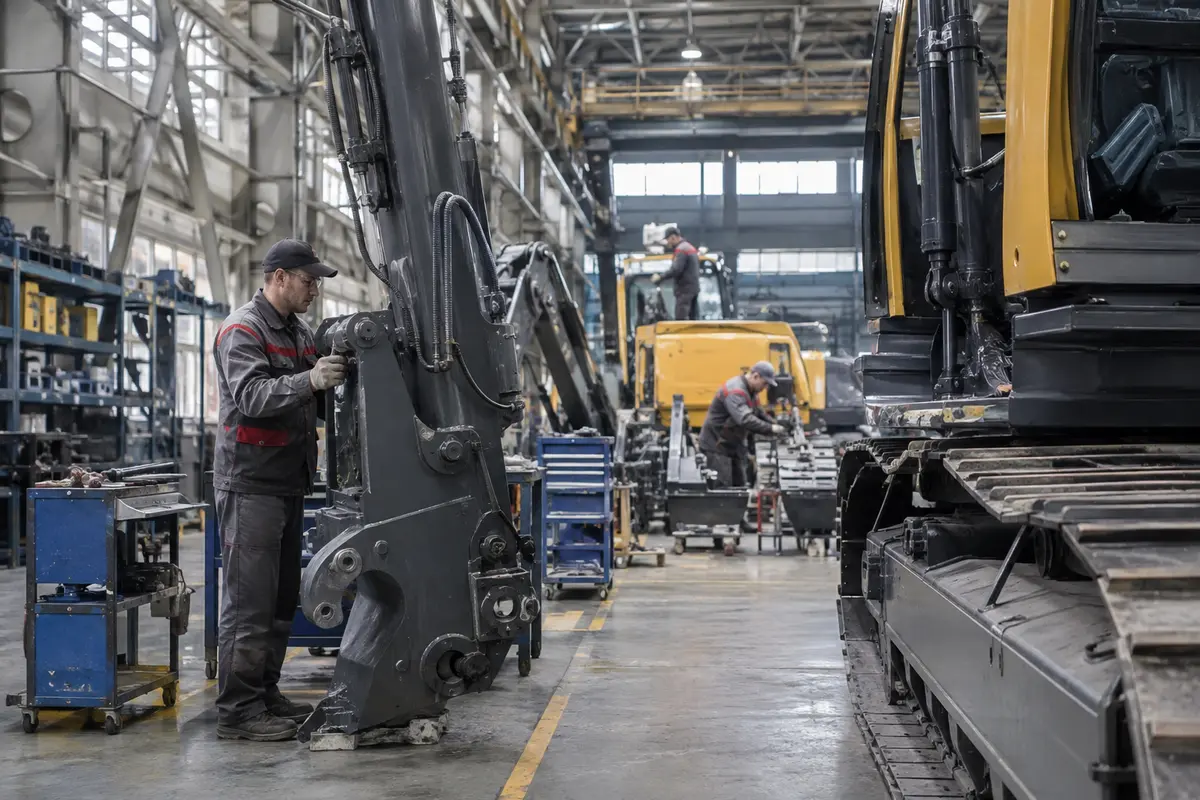
Deserving separate attention is the shift inside the investment structure itself: the share of investment in residential buildings and intellectual property assets rose, while the share of machinery and equipment fell. For the theme of this analysis, this is perhaps the most important line of the year. Machinery and equipment are the part of capital investment that directly creates production capacity; housing and intellectual property serve other purposes. When the structure shifts from machines to housing and intangible assets, the economy is literally putting less into what expands output and more into what does not.
The supply of investment goods: 88.2% of the mid-2024 level
The demand-side picture is complemented and confirmed by the supply side. By the calculations of TsMAKP (ЦМАКП), the supply of investment goods at the end of 2025 stood at 88.2% of the mid-2024 level. This means that roughly an eighth of supply left the market for investment goods: what shrank was not only demand for equipment and building materials but also their production and delivery.
The start of 2026 did not break this line: in TsMAKP's estimate, output of investment goods in January fell by 7.2% month on month, seasonally adjusted. A January minus of that size, after four quarters of a deepening annual decline, says that producers of investment goods keep adjusting output to a shrunken market rather than preparing for its recovery.
The interconnection of demand and supply forms here a loop that matters for any forecast. Fewer investment projects mean fewer orders for investment goods; lower output of investment goods makes any new construction and fitting-out more expensive and slower; more expensive fitting-out means fewer new projects. Only an external impulse can break this loop: an easing of monetary policy, a revival of final demand, or a new wave of state orders. The data of early 2026 show none of these impulses yet.
From expansion to maintenance: surveys as the structural signal
The key answer to the question of what exactly happened to investment comes from enterprise surveys. According to Bank of Russia monitoring, maintaining existing capacity was named as their investment strategy in 2025 by about 60% of companies, modernization by 42%, and expansion by only 28%. The distribution is eloquent: maintenance is the strategy of a confident majority, expansion the strategy of a minority, less widespread even than modernization.
- maintaining existing capacity — about 60% of companies;
- modernization — 42% of companies;
- expansion of production — 28% of companies.
The same Bank of Russia monitoring records the reason for this ordering of priorities: the share of enterprises complaining about insufficient demand rose over the year by 7 percentage points, to 22%. When more than a fifth of companies say plainly that demand is lacking, the logic of "first load what you have, then think about what is new" becomes dominant. Expanding capacity in conditions of insufficient demand is not an investment; it is a deliberate risk.
Independent confirmation comes from the survey of INP RAS (ИНП РАН): 65% of industrial enterprises name as the main obstacles to investment uncertainty, high interest rates and the availability of equipment. The three named barriers fold into a single formula of waiting: it is unclear what demand and the rules of the game will be; borrowing is expensive; the equipment needed is hard to buy. Under such a set of constraints, the rational strategy of a firm is to postpone the new project and maintain the operating production — which is exactly what the Bank of Russia survey figures show.
It is here that the annual minus 2.3% stops being merely a number of the cycle. If the decline were only the consequence of expensive money, it would look like a pause: companies would postpone projects but keep the intention to expand. The surveys show something else: the intention to expand has become a minority strategy, while maintaining capacity has become the norm for the majority. This is the structural signal of 2025: the investment model of the economy has shifted from expansion to maintenance.
The profit base of investment: minus 3.9% and own funds at a record
The financial foundation of the investment process sagged in 2025 as well. According to Rosstat, excluding small business, banks and state institutions, the financial result of enterprises fell by 3.9% year on year. The sectoral details explain where exactly the hole in profits opened: the coal industry finished the year with a loss of 408 billion rubles, while profit in the oil and gas sector fell by 64%, to 1.9 trillion rubles.
- financial result of enterprises overall: minus 3.9% year on year;
- coal industry: a loss of 408 billion rubles;
- oil and gas sector: minus 64%, to 1.9 trillion rubles of profit.
Against this background the second financial figure of the year is especially expressive: the share of own funds in capital investment reached about 59% — a historical maximum, exceeded only by the reading of 1997. The paradox here is only apparent. Own funds occupy a record share in investment not because profits are growing but because the alternative — borrowed money — became too expensive under tight monetary policy, while the profitable donor sectors shrank their contribution. The investments of 2025 were financed mainly out of a shrinking profit, and this is one more explanation of their selectivity: out of own profit, what gets paid for first is the maintenance of what already works, not the construction of what does not yet exist.
Entering 2026: plans worse than the crisis ones
The data of early 2026 show that if a turning point is emerging anywhere, it is not in business sentiment. In the estimate of INP RAS, the composite indicator of investment plans of industrial enterprises fell by 35 points in February 2026; pessimism had been stronger only in November 2025, when it reached its worst values since the crisis of 2008–2009. In other words, the February plans of business are only slightly better than the November trough, comparable in depth of pessimism to the era of the global financial crisis.

The forecasts for 2026 continue this line. The Economy Ministry expects fixed capital investment to shrink by 0.5%, and the Interfax consensus expects zero change. Even the most optimistic of the two scenarios means stagnation: after minus 2.3% in 2025, a zero in 2026 is not a return to growth but merely a halt to the decline. The ministry's forecast goes further and directly builds in a second consecutive year of contraction.
For the change of regime described above, this means a simple thing: for the maintenance of capacity to turn back into expansion, it is not individual indicators that must change but the whole set of conditions — demand, the policy rate, the certainty of the rules and the availability of equipment. As long as the February plans of business sit 35 points below the usual norm and the supply of investment goods keeps shrinking, the data give no grounds to expect such a reversal already in 2026.
Conclusion: an economy of maintained capacity
Taken together, the lines of 2025 draw not a crisis of investment but a change of its model. An annual minus 2.3% at a level of investment close to the maximum of recent years; a deepening quarterly decline from plus 6.5% to minus 5.3%; a gap between the outcome and the consensus of roughly three percentage points; a minus in transport, construction and agriculture against a plus 11% in manufacturing on state demand; a shift of the investment structure from machinery and equipment toward housing and intellectual property; a supply of investment goods at 88.2% of the mid-2024 level; maintenance of capacity as the strategy of about 60% of companies against 28% for expansion; a financial result of minus 3.9% alongside a share of own funds at a record not seen since 1997; February investment plans at minus 35 points and a forecast for 2026 ranging from minus 0.5% to zero.
Each of these figures taken separately admits a cyclical explanation. Together they fold into a structural signal: the Russian investment cycle has moved from expanding production capacity to maintaining it. Such a regime can be long and relatively painless — the level of investment remains high, manufacturing grows on state orders — but it means that the addition of capacity on which the output of earlier years rested stops reproducing itself. The question of 2026, therefore, is not whether the annual figure turns positive, but when and under what conditions maintenance will turn back into expansion. For now the answer to that question is given not by forecasts but by surveys: business chooses to preserve what it has.















Leave a comment