Malaysia's 2025 Market Year in Review: the 'T&A' Shock, Ten of Thirteen Bursa Sectors in the Red, and the Four Questions That Will Drive 2026
When the equity market of Malaysia closed the books on 2025, the year refused to fit a single narrative. Globally it was the year of “T&A” — Trump, tariffs and tech, with the artificial-intelligence boom carrying United States equities upward — while at home the benchmark Kuala Lumpur Composite Index ended the calendar roughly where it had stood for much of the previous thirteen years, essentially unchanged. Behind that flat headline the year was anything but quiet: ten of the thirteen sectoral indices on Bursa Malaysia finished 2025 in the red, with healthcare down 36.4%, technology down 12.1% and telecoms down 11.3%, and only real estate investment trusts, plantation and financials closing the year with gains of 7.3%, 6.6% and 0.3% respectively. This analysis unpacks the year-end review published by The Edge Malaysia on December 29, 2025: what the “T&A” label actually captures, why a global AI rally left the Malaysian market behind, what the sector scoreboard reveals about the internals of the exchange, which four questions will drive 2026, and which policy supports and investment themes the review places on the watchlist for the year ahead.
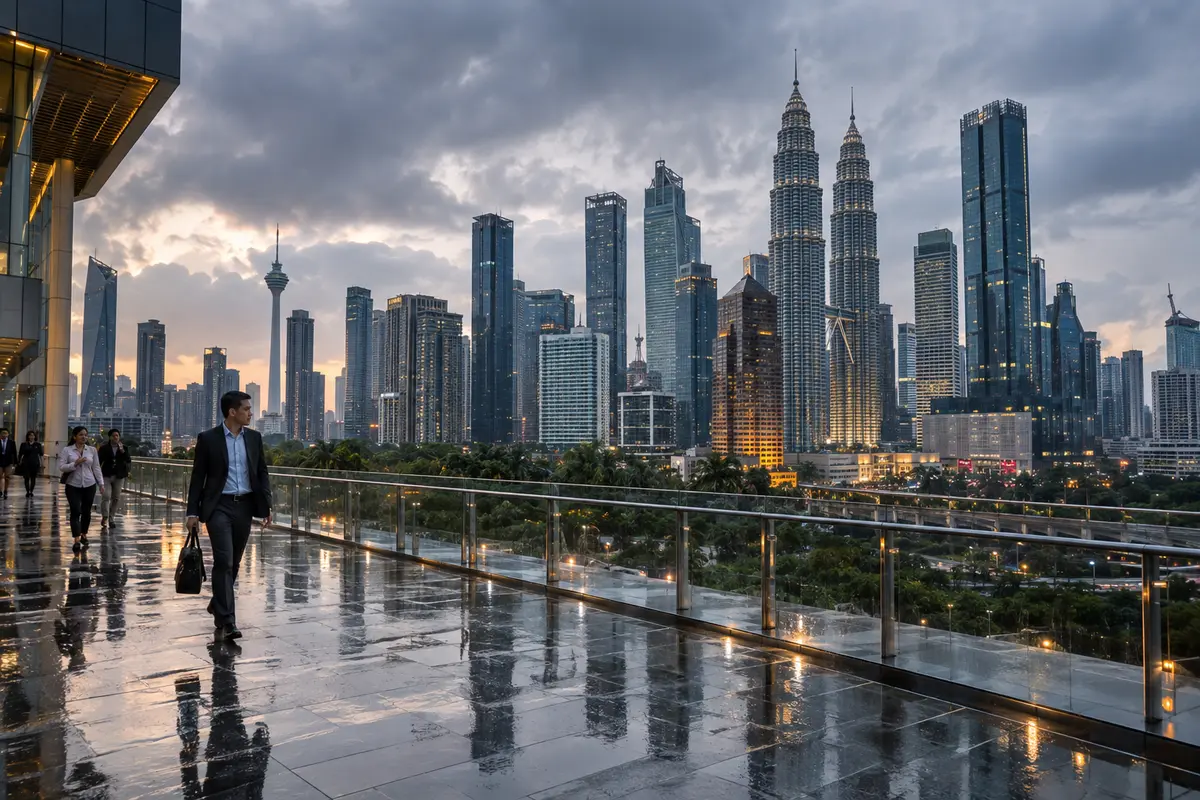
The year of “T&A”: how 2025 acquired its initials
Every market year acquires a shorthand, and the shorthand the year-end review assigns to 2025 is “T&A”: Trump, tariffs and tech, with the artificial-intelligence wave riding on top of all three. The label is more than wordplay. It compresses the three forces that set the global tone for asset prices across the twelve months — a United States political cycle that rewrote the rules of trade, a tariff regime that re-priced supply chains and the companies built on them, and a technology complex in which artificial intelligence became the single dominant claim on investor capital. In the review's telling, United States equities rode exactly that combination: the AI boom supplied the earnings narrative, the tariff shock supplied the volatility, and the two together kept American markets at the centre of global attention throughout the year.
Malaysia's experience of the same twelve months was different in kind, not merely in degree. The review describes a market that languished while the American complex boomed: a benchmark index that ended the year roughly flat, and a sectoral tape in which the majority of industries lost ground. The contrast is the analytical core of the year-end assessment, because it rules out the simplest explanation of a weak domestic market — a weak world. The world, or at least the largest and most influential part of it, was not weak in 2025. It was euphoric about a narrow set of themes. The Malaysian market's problem was that it did not own those themes in the proportions that global capital wanted to buy, and the year-end review makes that mismatch the starting point for everything that follows.
A label that carries the whole year
It is worth pausing on what a two-letter label does to a complex year. “T&A” tells the reader where the energy came from: policy shock and technological narrative, intertwined. It also tells the reader where the energy did not go. A market whose listed base is weighted toward healthcare services, technology manufacturing, telecommunications, plantations, banks and property does not automatically participate in a rally concentrated in a handful of American artificial-intelligence champions. The label therefore works as a diagnostic as much as a slogan: it names the engine of the global cycle and, by omission, explains why an exchange with a different composition was left watching that cycle from the outside.
Two markets, one calendar: the AI rally against a thirteen-year plateau
The single most arresting fact in the year-end review is not a 2025 number at all. It is the observation that the Malaysian benchmark index ended the year roughly where it had been for about thirteen years — that is, a broad equity market that, measured at the index level, has delivered essentially no growth across more than a decade. Thirteen years spans multiple global cycles: commodity supercycles and their collapse, a pandemic and the monetary experiment that followed it, and now the artificial-intelligence boom. An index that closes 2025 near the level at which it traded thirteen years earlier has, by definition, absorbed all of those cycles without accumulating any net progress for the holder of the index itself.
Set against that plateau, the American side of the 2025 story looks almost like a different asset class. United States equities rode the artificial-intelligence boom to a year of gains concentrated in the technology complex, and the review frames the divergence between the two markets as the defining visual of the year: one market climbing on a powerful narrative, the other treading water on an index that has trod water before. The point is not that Malaysia's economy stood still — the review's own list of 2026 supports and themes implies an economy with real investment pipelines — but that the equity market, as measured by its headline index, failed to convert any of that activity into index-level appreciation over a very long horizon.
That distinction matters for how 2025 should be read. A flat index in a flat world would be unremarkable. A flat index in a world where the dominant capital pool was actively searching for growth assets is a statement about composition, ownership and flows: about what the index contains, about who holds it, and about where marginal global money chose to go instead. The sectoral scoreboard, examined next, is where those abstract questions become concrete.
What a thirteen-year plateau does to a market
A decade and a half without index-level growth leaves marks beyond the price chart. It shapes the domestic investor base, because households and institutions that experienced earlier disappointments allocate elsewhere. It shapes foreign ownership, because global portfolios benchmarked against growth indices find little reason to overweight a market whose headline has not moved. And it raises the bar for any 2026 recovery narrative: after thirteen flat years, a credible re-rating requires not merely a good year but a change in what the market is perceived to be. The review's 2026 driver list — yield spreads and foreign portfolio rebalancing — is, read carefully, a list of the mechanisms through which such a perception change would have to travel.
The sector scoreboard: ten of thirteen in the red
The index plateau conceals a year of violent internal dispersion. Of the thirteen sectoral indices tracked on Bursa Malaysia, ten finished 2025 with losses. The review names the deepest of them: healthcare down 36.4%, technology down 12.1% and telecoms down 11.3%. The remaining seven losing sectors are not itemised in the review, but the arithmetic of the scoreboard is stark on its own — a market in which more than three quarters of its industries lost money for the year is not a market that was merely overlooked by the global AI rally; it is a market in which domestic and regional selling pressure, de-rating and sector-specific disappointment did substantial work.
- healthcare — down 36.4%, the deepest sectoral decline of the year;
- technology — down 12.1%, a sector that elsewhere in the world was the engine of the AI rally;
- telecoms — down 11.3%, extending the pressure on domestically oriented network operators;
- seven further sectoral indices also closed 2025 in the red, bringing the losing tally to ten of thirteen;
- only three sectors escaped: real estate investment trusts, plantation and financials.
Two features of this list deserve emphasis. The first is the depth of the healthcare decline: a loss of more than a third of sectoral value in a single year is a repricing event, not a drift, and it alone would drag any index in which the sector carries weight. The second is the irony of the technology line. In 2025 the global technology complex was the beneficiary of the artificial-intelligence boom; the Malaysian technology sector, by contrast, ended the year down 12.1%. The same label — “tech” — described a winner in one market and a loser in another, which is precisely the composition mismatch that the “T&A” framing implies.
The three that held: REITs, plantation and financials
Against ten losing sectors, three closed the year in positive territory, and the review's figures rank them clearly:
- real estate investment trusts, up 7.3%, the strongest sectoral performance of the year;
- plantation, up 6.6%, the commodity-linked complex doing what it has historically done for the Malaysian tape in difficult years;
- financials, up 0.3%, a bare positive that nonetheless kept the banking complex out of the losing column.
The pattern in the survivors is instructive. The two strongest performers — REITs and plantation — are income and commodity stories rather than growth stories: assets valued for distributable cash and for commodity prices rather than for participation in a technological narrative. Financials, barely positive, complete a picture in which the defensive and income-generating parts of the market held while the growth-sensitive parts fell. In a year dominated globally by a growth narrative, the Malaysian market's positive column was written by the assets least dependent on that narrative. That inversion is the cleanest single summary of what 2025 did to this exchange.
Reading the divergence: why the AI boom did not lift Malaysia
The natural question after the scoreboard is mechanical: if global capital was paying record attention to artificial intelligence in 2025, why did a Southeast Asian exchange with a substantial technology-manufacturing base not participate? The review's answer is implicit in its structure rather than stated as a formula, but the structure points in a consistent direction. Participation in a global thematic rally requires that the listed supply of the theme matches the demand of global capital, and that the marginal holder of the index is willing to pay up for it. The 2025 evidence — a flat index, ten losing sectors, a technology sector in the red while its American counterparts boomed — indicates that at least one of those conditions failed for Malaysia.
The review's forward-looking section supplies the vocabulary for the missing ingredient: flows. When it identifies the narrowing of the United States–Malaysia yield gap and the possibility of foreign portfolio rebalancing as the main potential market drivers for 2026, it is effectively conceding that 2025 was decided by the opposite configuration — a yield and flow environment in which foreign capital had better uses elsewhere. An index that has not grown in about thirteen years is, in flow terms, an index that marginal money has repeatedly chosen to leave or avoid. The AI boom of 2025 did not reverse that habit; if anything, by concentrating global enthusiasm in a narrow set of American names, it reinforced it.
None of this is a verdict on the Malaysian economy's real activity. Investment themes cited by the review for 2026 — data centres, the Johor–Singapore special economic zone, infrastructure in Sarawak and Sabah — describe capital formation that is genuinely underway. The divergence of 2025 is a statement about the equity market's ability to price that activity, and about whose money does the pricing. That is why the review's 2026 framework is built around flows and spreads rather than around earnings narratives alone.
2026: the four questions that will move the market
The year-end review organises the outlook around a short list of watch items, and the list is notable for how little of it is domestic. The first two questions sit in the United States, the third in the relative pricing of the two countries' bonds, and the fourth in the behaviour of foreign portfolio money. Together they form the review's map of 2026:
- whether the artificial-intelligence rally proves to be a bubble — the question that governs the global risk environment in which every other asset, including Malaysian equities, must trade;
- the state of Main Street jobs and consumption in the United States — the real-economy counterpart to the AI narrative, and the test of whether the boom has broad foundations or narrow ones;
- the narrowing of the yield gap between the United States and Malaysia — the relative-price channel through which the attractiveness of Malaysian assets is re-computed;
- the possibility of foreign portfolio rebalancing — the flow event that would convert any change in relative attractiveness into actual buying in the Malaysian market.
The ordering matters. The first two items determine whether global capital is in a risk-on or risk-off posture; the third determines whether Malaysia looks cheap or expensive within whatever posture prevails; the fourth determines whether anyone acts on that assessment. A market can be right about its own valuation and still not move if the flow does not arrive — and after a thirteen-year index plateau, the review treats the arrival of flow as the variable to watch, not as a given.
The yield-spread channel, qualitatively
The yield-gap item deserves a plain-language gloss because it is the most technical of the four. Capital that can be invested across borders compares what it earns for bearing comparable risk in different currencies and markets. When the gap between United States and Malaysian yields is wide, the comparison favours leaving money in the higher-yielding alternative; when the gap narrows, the comparison shifts, and assets denominated in the lower-yielding currency become relatively more interesting. The review does not attach numbers to this channel; it identifies the direction to watch. For an equity market starved of foreign flow, a narrowing spread is the kind of slow, unglamorous variable that can nonetheless change who owns the index — which is exactly the change the 2026 framework is built to detect.

The supports: policy anchors and macro cushions
The review balances its watch items with a list of supports, and the list is deliberately structural rather than cyclical. Five items carry the weight:
- the 13th Malaysia Plan, the national development framework that sets the medium-term investment and policy direction;
- Budget 2026, the annual fiscal statement through which spending priorities and incentives reach the economy;
- low inflation, the macro cushion that preserves household purchasing power and gives the central bank room to manoeuvre;
- fiscal reforms, the programme of changes to how public revenue is raised and managed;
- a current account surplus, the external balance that underwrites the currency and the country's claim on foreign income.
Read together, these five supports describe an economy with policy direction, fiscal capacity, price stability and external strength. None of them is a stock-market catalyst in itself, and the review does not present them as one. Their function in the 2026 framework is to define the floor: the set of conditions under which a flow-driven re-rating, if the yield spread and foreign rebalancing align, would land on an economy capable of absorbing it. A market that has not grown in thirteen years does not need more narrative; it needs reasons for marginal capital to believe the narrative will be paid for. Policy anchors and macro cushions are the grammar of those reasons.
Themes to watch: data centres, the Johor–Singapore SEZ, East Malaysia, plantation and banks
The final layer of the year-end review is its theme list for 2026, and it reads as a map of where the Malaysian investment story is physically being built. Data centres come first: the compute infrastructure that the global artificial-intelligence boom demands, and the closest thing the Malaysian market has to direct exposure to the theme that dominated 2025 elsewhere. The Johor–Singapore special economic zone follows, a cross-border arrangement that turns geography into an industrial and logistics proposition. Infrastructure in Sarawak and Sabah extends the map to East Malaysia, where development spending and resource-linked projects form a distinct regional story. Plantation and banks complete the list — the commodity complex and the financial complex that, not coincidentally, supplied two of the three positive sectors in the 2025 scoreboard.
The overlap between the theme list and the survivor list is the most actionable observation in the review. Plantation and financials were not merely defensive holdings in 2025; they enter 2026 as named themes with their own investment pipelines. Meanwhile the data-centre and special-economic-zone themes offer the market something it lacked in 2025: listed exposure to the global technology cycle that left it behind. Whether that exposure is enough to change the index's thirteen-year habit is precisely the question the 2026 framework — bubble risk, American consumption, yield spreads, foreign rebalancing — is designed to answer over the coming twelve months.
From themes to prices
Themes become prices only through flows, and flows respond to the four watch items in order. A data-centre pipeline can be real, a special economic zone can be legislated and East Malaysian infrastructure can be under construction, while the index still fails to re-rate if global capital remains concentrated elsewhere. The review's discipline is to hold both truths at once: the building is happening, and the pricing of the building depends on variables set largely outside the country. Investors reading the 2026 map are therefore reading two documents in one — a domestic investment agenda, and a foreign flow environment that must cooperate for the agenda to show up in valuations.
What the year-end review teaches
Stripped to its essentials, the year-end assessment of 2025 makes three claims. First, the year belonged globally to “T&A” — Trump, tariffs, tech and the artificial-intelligence boom — and that combination lifted United States equities while leaving Malaysia's benchmark roughly where thirteen years of history had already placed it. Second, the flat headline concealed a brutal internal year: ten of thirteen sectors in the red, healthcare down more than a third, technology and telecoms double-digit losers, with income and commodity assets — REITs, plantation and barely-positive financials — writing the only positive lines. Third, 2026 turns on a chain of external conditions: whether the AI rally is a bubble, whether American jobs and consumption hold, whether the United States–Malaysia yield gap narrows, and whether foreign portfolios rebalance toward the market — with the 13th Malaysia Plan, Budget 2026, low inflation, fiscal reforms and the current account surplus as the domestic floor beneath that chain.
For readers of the Malaysian market, the lesson is not pessimism but precision. The exchange's problem in 2025 was not the absence of a domestic story; the theme list shows a story under construction from data centres to East Malaysia. The problem was that the pricing of the story sits with capital that spent the year elsewhere. The year-end review's watchlist is, in the end, a description of the conditions under which that capital might return — and of the supports that will matter if it does.


















Leave a comment