Economists Read Malaysia's June 2024 Export Slowdown as a Base-Effect Wobble Inside the Semiconductor Upcycle
Malaysia's June 2024 export print landed below expectations: shipments grew 1.7% year-on-year to RM126.05 billion, against a Bloomberg consensus of 3.3%, marking the second consecutive month of deceleration. And yet the economists who follow the country's trade engine most closely — RHB Bank, UOB and MIDF Research — declined to read the slowdown as a turning point. In their framing, June is a base-effect wobble sitting inside a semiconductor-driven upcycle, not the first crack in it. This analysis puts a narrower question to the June data: which parts of the print are arithmetic, which are signal, and what the import side, running far hotter than the export side, implies for the second half of 2024 and for the current account.
The stakes of that question are practical rather than academic. Malaysia's external sector is the transmission belt between the global technology cycle and the domestic economy: it decides factory utilisation in Penang and the Kulim corridor, it decides the size of the trade surplus that funds the current account, and it decides how much external buffer the ringgit sits on when global financial conditions tighten. A June print that is misread in either direction — as collapse or as confirmation — distorts the planning horizon of exactly the firms whose order books the data is supposed to describe.
The June print: a deceleration with an alibi
Exports of RM126.05 billion in June 2024 compare with RM123.94 billion in June 2023, a 1.7% gain that undershot the 3.3% consensus and extended a deceleration that had already begun in May. The composition explains part of the miss: manufactured goods and agricultural goods were sluggish on the month, and the comparison base was unforgiving, because June 2023 had itself been a strong month for shipments. When a strong base meets a merely adequate outturn, the growth rate compresses even if the absolute level of trade remains high — and RM126.05 billion is, in level terms, a healthy month for Malaysian trade.
Three features of the June print deserve to be separated before any judgement about the cycle:
- the growth rate, at 1.7%, is the weakest element of the release and the one most exposed to base effects, because it is measured against an unusually strong June 2023;
- the composition, with manufactured and agricultural goods sluggish, locates the weakness outside the electrical and electronics complex that carries the upcycle thesis;
- the trade surplus, at RM14.3 billion, is a nine-month high — a figure that is difficult to reconcile with any narrative of broad export distress, because a widening surplus means exports are outpacing imports on the month even while their growth rate slows.
The nine-month-high surplus also disciplines the debate about composition. A surplus of RM14.3 billion in the same month that export growth slowed to 1.7% means the slowdown was not bought with import strength: on the month, imports grew more slowly than exports and the external account widened. Composition weakness that coexists with a widening surplus is a mix problem inside a growing trade engine, not a demand problem across it — and mix problems are corrected by the order book, while demand problems are corrected only by the world economy.
Why the base effect is the honest explanation
A base effect is not an excuse; it is arithmetic that must eventually reverse. The June 2023 comparison base was elevated, so the June 2024 growth rate is mechanically depressed, and the mirror image arrives in the second half of 2024, when the comparison bases soften. That is precisely the mechanism behind MIDF Research's expectation that export momentum improves in the latter part of the year: the same series that looks tired against a strong base looks vigorous against a weak one, without any change in the underlying order book. The analytical error to avoid is treating a base-driven deceleration as demand-driven deceleration. Demand-driven slowdowns show up first in volumes and in new orders; base-driven slowdowns show up first in growth rates while levels hold. June 2024, with RM126.05 billion of shipments and a nine-month-high surplus, fits the second pattern.
RHB: one data point against a +19.3% semiconductor market
RHB Bank's reading of the cycle rests on the global semiconductor market rather than on any single Malaysian month. The bank notes that electrical and electronics export momentum has shown sustained improvement since early 2024, and it anchors that observation in the world market: global semiconductor sales grew 19.3% year-on-year in May 2024, with the Americas and the Asia-Pacific region doing most of the driving. Against that backdrop, RHB maintains a positive trade outlook for 2024 despite the June slowdown, arguing in effect that one isolated data point in June does not carry enough information to overturn an optimistic view built on a market expanding at nearly a fifth year-on-year.
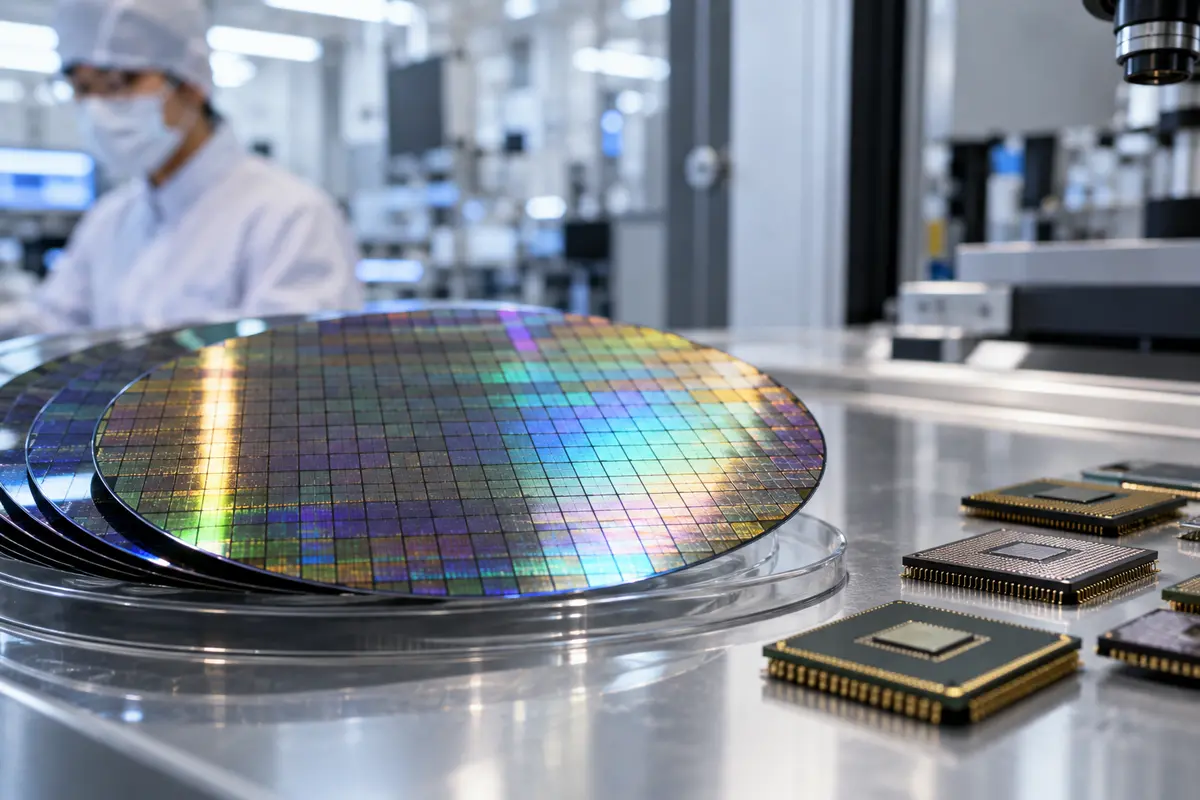
The logic deserves scrutiny because it is the load-bearing wall of the upcycle thesis. Malaysia's position in the semiconductor chain is concentrated in the back end — assembly, testing and packaging — where revenue follows the volume of wafers started elsewhere with a lag. A 19.3% expansion in global semiconductor sales is therefore not a coincident indicator for Malaysian E&E exports but a leading one: the orders that the world market places today become Malaysian export lines one to two quarters from now. That lag structure is exactly why a single soft month in the middle of 2024 can coexist with an intact upcycle — the month reflects orders placed when the world market was weaker, while the second half of 2024 will reflect orders placed into a market growing at double digits.
The import signal: intermediate goods as the leading indicator
The strongest evidence in the June release is not on the export side at all. Imports rose 17.8% year-on-year, and within them intermediate goods — the components and semi-finished inputs that factories buy in order to sell finished goods later — jumped 37.2%, extending a run of double-digit intermediate-goods import growth to a seventh consecutive month. Firms do not buy 37.2% more inputs than a year earlier to feed a shrinking order book. MIDF Research ties the import strength to higher new orders from Asia-Pacific customers, naming Australia, the Philippines and Vietnam among the sources of demand, and reads the combination as confirmation that export momentum improves into the latter part of 2024.

The half-year aggregate sharpens the picture. Over the first half of 2024, imports grew 13.8% while exports grew 3.9% — a wedge of nearly ten percentage points in favour of the input side. On the strength of that wedge, MIDF Research upgraded its full-year import growth forecast to 11.2%. In an assembly-and-test economy, an import surge of this shape is the footprint of future exports: components cross the border, acquire value in Malaysian plants, and leave again as E&E shipments. The sequence has a reliable order — intermediate imports first, exports later — which is why the import line is the most useful single indicator in the entire release.
What the wedge prices in, and what it cannot prove
Two cautions keep the import signal honest. First, intermediate-goods intensity is a statement about the E&E chain specifically; it says less about the manufactured and agricultural lines that dragged June's export composition, and those lines have their own demand drivers. Second, imports that outrun exports compress the trade surplus in the months before the export catch-up arrives, so a period of hot imports can coexist with a temporarily thinner surplus even in a healthy cycle. June's RM14.3 billion surplus shows that the catch-up is already partly in train, but the 1H wedge of 13.8% against 3.9% means the second half carries the burden of converting inputs into shipments. If it does, the upcycle reading is confirmed in the export line itself; if it does not, the import surge will have been inventory build rather than order book, and the revision would show up as a surplus that fails to widen into year-end.
Second-half outlook: UOB's 3.5% and MIDF's improving momentum
UOB kept its full-year 2024 export growth forecast at 3.5%, a number that already embeds a soft June. The bank's framework rests on a recovery in world trade and a soft landing in the major economies, offset by logistic challenges and geopolitical risks that cap the upside. Within that frame, UOB identifies two sources of upside: a more robust improvement in electrical and electronics exports, and commodity earnings supported by prices. It pairs the upside with a specific caution — commodity exports remain subject to production shocks, including plant maintenance closures and price fluctuations — which is a reminder that the non-E&E half of the export basket is supply-constrained as often as it is demand-constrained.
MIDF Research's position is the more directional of the two: export momentum improves in the latter part of 2024, with the E&E recovery becoming more encouraging in the second half on the back of improvement in the global E&E market. Read together with RHB's semiconductor anchor, the three houses form a consistent stack — a world market expanding at double digits, a Malaysian import line already pricing it in, and a full-year export forecast of 3.5% that looks conservative precisely because the base effects turn favourable in the months ahead.
Placed side by side, the three forecasts describe a single corridor rather than a dispute. UOB's 3.5% sets the conservative floor because it prices logistic and geopolitical drag at full weight; MIDF Research's improving-momentum call sets the direction of travel within the year; RHB Bank's semiconductor anchor sets the ceiling of plausibility, since Malaysian E&E exports cannot outrun for long the world market that feeds them. A corridor with a named floor, a named direction and a named ceiling is a forecast stack that can be tested month by month — which is more than most consensus positions offer.
Where the consensus could break
The stack has three visible failure points. A renewed downturn in global technology demand would invalidate the leading indicator at its source, turning the import surge into unwanted inventory. A commodity shock — a maintenance closure at a major plant or a sharp price move — would remove UOB's second upside channel at exactly the moment the E&E channel is expected to carry the year. And a logistics or geopolitical disruption, the risk UOB explicitly names, would interrupt the physical conversion of imported inputs into exported output, producing the worst combination of all: hot imports and cold exports in the same quarter. None of the three is the base case; all three are observable, which is what makes them watchable rather than merely worrisome.
From trade surplus to current account: the RM39–41.5 billion corridor
The trade surplus is the bridge between the monthly print and the annual external position, and June's RM14.3 billion — a nine-month high — is a strong plank in it. UOB projects a 2024 current account surplus of RM39 billion, equal to about 2% of GDP, a figure the bank presents as in line with Bank Negara Malaysia's own projection of RM41.5 billion, or 1.8% to 2.8% of GDP. Either number would be a substantial advance on 2023, when the current account surplus was RM28.2 billion, or 1.5% of GDP.
The progression matters beyond the headline. A current account surplus of roughly 2% of GDP is net foreign earnings that accumulate as external buffers: reserves, net external assets, and the capacity to absorb capital-flow volatility without domestic tightening. For an economy whose currency is priced largely by external conditions, the current account is the slow variable that determines how much fast-variable noise the ringgit can absorb. The June surplus, the seven-month run of double-digit intermediate imports and the second-half export catch-up are, in this frame, three views of the same object — a widening external cushion being built one shipment at a time.
Verdict: a wobble inside an upcycle, with a watchlist
The June 2024 data supports the economists' reading more than it challenges it. The deceleration sits where base effects and non-E&E composition say it should sit; the surplus sits at a nine-month high; and the import line, the most forward-looking series in the release, is expanding at rates that only make sense against a growing order book. The honest formulation is that June is a wobble inside an upcycle — visible, explainable, and scheduled to reverse as the comparison bases soften — rather than evidence that the upcycle has stalled. What separates that formulation from wishful thinking is the watchlist:
- the export catch-up in the second half of 2024: monthly export growth re-accelerating as bases soften would confirm that the 1H import wedge was order book rather than inventory;
- intermediate-goods imports: a seventh month of double-digit growth is the signal; the first month of single-digit growth in the category would be the counter-signal;
- global semiconductor sales: the +19.3% year-on-year May 2024 pace is RHB's anchor, and a deceleration there reaches Malaysian E&E exports with a one-to-two-quarter lag;
- the commodity line: maintenance closures and price swings are UOB's named downside channel, and they can move the full-year 3.5% forecast on their own;
- the current account corridor: UOB's RM39 billion and Bank Negara Malaysia's RM41.5 billion against 2023's RM28.2 billion define the range within which the external buffer story holds.
On the evidence available in July 2024, the cycle is intact, the leading indicators point forward, and the external position is set to widen. The June print is the part of the story that will age worst — and, on the economists' reading, the part that was never the story. The June 2024 trade data and the economists' assessments were reported by The Edge Malaysia on Jul 18, 2024.


















Leave a comment