Russia's Machine Tools as a Technological Sovereignty Project: From 2.5-Fold Growth to the 60% Target of 2030
Machine tool production in Russia has grown more than 2.5-fold over the past four years, according to the Ministry of Industry and Trade (Минпромторг). Yet volume is only half of the story. The industry's declared destination is a 2030 horizon in which domestic machine tools hold 60 percent of the home market, the total output of machine-tool and tooling products stands at twice the 2022 level, and at least 16 new types of specialized high-tech equipment have entered production — a programme reported by the Kommersant daily on December 11, 2025 in an article by Ekaterina Kuznetsova.
This article reads that programme as a project of technological sovereignty rather than a simple expansion plan, and it asks a narrower question: what converts a 2.5-fold increase in output into a 60 percent share of the market? The answer developed below is that a specific demand-side instrument — a customer discount that the state compensates to the manufacturer, applied to machine tools listed in the register of Russian industrial products — together with the purchasing power of the state customer, forms the bridge between the supply-side growth already achieved and the market-share target still ahead. Two company cases described in the same reporting, Sasta (Саста) and Bivertech (Бивертех), show how that bridge is being built in practice.
More than 2.5-fold in four years: what the growth figure means
The starting point of the whole programme is a production fact: over the last four years the volume of Russian machine-tool and tooling products has increased by more than two and a half times, on the Ministry of Industry and Trade's own figures. A multiple of this size over a single four-year span is not incremental. It implies that the industry has added capacity, restarted or expanded product lines, and found buyers for the additional machines, because output of capital goods does not rise by 150 percent unless something is purchasing it.
But a growth multiple and a market share are different quantities, and the distinction is the analytical hinge of this article. A multiple measures how much more the industry produces than it did; a share measures how much of what the country buys comes from domestic plants. The first can rise while the second stays flat, if the overall market — domestic plus imported machines — grows at least as fast as domestic output. That is precisely the situation a catch-up industry faces: its own volume climbs steeply from a low base while the installed appetite for machine tools, fed for years by imports, remains large.
Recognising this gap explains why the 2030 package does not stop at a volume target. It pairs the doubling of output against 2022 with an explicit share target of 60 percent, and it adds a technological target on top. The three together acknowledge that producing more is necessary but not sufficient; the industry must also win the market and move up the technology ladder while doing so.
Three targets for 2030, three different kinds of goal
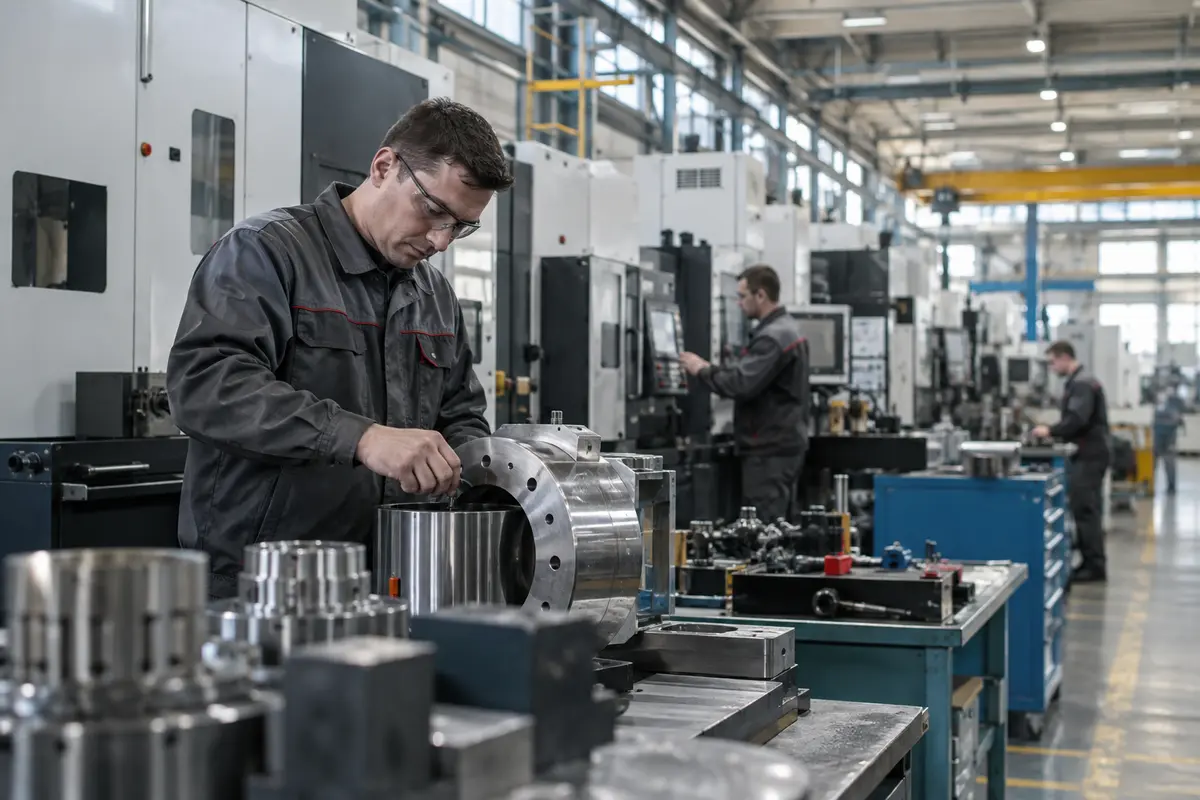
The 2030 horizon is expressed in three commitments, and they belong to three different categories of industrial policy.
- a 60 percent share for domestic machine tools on the home market — a relative, demand-side target that depends as much on imports as on domestic output;
- output of machine-tool and tooling products at twice the 2022 level — an absolute, supply-side target measured against a fixed base year;
- the development of at least 16 new types of specialized high-tech equipment for aviation and machine building — a qualitative, technological target about capability rather than volume.
The first target is the hardest to control, because a share is a ratio. Domestic producers can double their output and still lose share if imports grow faster; conversely they can gain share without growing if imports contract. A share target therefore cannot be met by supply-side effort alone — it requires acting on the demand side, on what buyers actually choose. This is where the discount-and-compensation instrument and the state customer enter, and it is why this article returns to them repeatedly.
The second target, doubling against 2022, is the most straightforward: it is a production commitment that the industry's recent 2.5-fold trajectory suggests is within reach, provided the expansion continues. The third target — at least 16 new types of specialized high-tech equipment for aviation and machine building — is the most demanding in a different way, because it is not about making more of what already exists but about mastering what does not yet exist in the domestic product range. It is a commitment to close specific technological gaps.
Why the mix of targets matters
Read together, the three targets describe a complete industrial strategy rather than a single number: grow the volume (the doubling), win the market (the 60 percent), and climb the technology ladder (the 16 new types). Each addresses a different failure mode. Volume alone would leave the industry large but peripheral; share alone would leave it dominant but technologically dependent; technology alone would leave it advanced but marginal in its own market. The programme's coherence lies in pursuing all three at once, and its difficulty lies in the fact that they pull on different levers.
The national project as the frame: means of production and automation
The institutional frame for all of this is the national project "Means of Production and Automation" (нацпроект «Средства производства и автоматизации»), which the reporting identifies as the backbone of the industry's development. Its scope covers three linked domains: the machine-tool and tooling industry itself, automation, and the efficiency of enterprises. Grouping these three under one project is a statement about how the state sees machine tools — not as a niche branch of engineering but as the means of production on which the efficiency of every other factory depends.
That framing has a practical consequence. If machine tools are treated as infrastructure, then their development is a public priority and not merely a commercial matter for the plants that build them. It justifies demand-side instruments, state-backed financing and a register of domestic products, because the object being supported is the country's capacity to equip itself. It also connects the industry to the wider language of technological sovereignty that runs through the statements of the sector's managers and officials.
The bridge: a compensated discount and the state customer
Here the article reaches its central question. The industry has already multiplied output by more than 2.5; the 2030 package demands a 60 percent share. What connects the two? The reporting points to a concrete instrument at one named plant: customers buying certain machines receive a discount, and the state compensates the manufacturer for the revenue it forgoes, for machines included in the register of Russian industrial products, with the measure running until 2027.
The logic of this instrument is worth unpacking, because it is the mechanism by which supply-side growth is converted into market share. A discount lowers the effective price a buyer pays for a domestic machine, closing part of the gap — real or perceived — between a domestic offer and an imported alternative. Crucially, the discount is not absorbed by the manufacturer: the state compensates the foregone revenue. The plant therefore does not have to choose between margin and market share; it can price competitively while remaining financially whole. That removes the classic obstacle to import substitution, where domestic producers either price at cost and starve, or price for margin and lose the order.
The register of Russian industrial products is the gate that makes the instrument credible. Only machines on the register qualify, which ties the subsidy to verified domestic origin and, implicitly, to a defined product standard. The discount is thus not a general handout but a targeted incentive attached to a certified domestic product.
The second half of the bridge is demand itself. The first deputy prime minister Denis Manturov (Денис Мантуров), as reported, sets out a two-sided instruction: for the plants, an emphasis on new product lines and technical re-equipment; for the customers, advanced technical specifications and a priority for Russian machine tools. The customer side of that instruction is the state using its own purchasing power and its technical requirements to steer orders toward domestic machines. A compensated discount makes the domestic machine affordable; the state customer's priority makes it the default choice. Together they act on both price and preference — the two variables that determine share.
- The discount lowers the buyer's effective price for a domestic machine, narrowing the gap to imported alternatives.
- State compensation of the foregone revenue keeps the manufacturer financially whole, so the discount is sustainable rather than a one-off concession.
- The register of Russian industrial products defines which machines qualify, tying the incentive to verified domestic origin.
- The state customer's advanced technical specifications and priority for Russian machines guarantee an order book and set the direction of demand.
- With price and preference both addressed, added production capacity is absorbed into actual market share, moving the 60 percent target within reach.
This is why the discount-with-compensation measure and state demand are best understood as a bridge rather than as isolated subsidies. A subsidy to a plant builds capacity; a bridge built from compensated discounts and state purchasing converts that capacity into share. The 2027 horizon of the discount measure and the 2030 horizon of the targets are consistent with this reading: the demand-side bridge is laid first, giving domestic machines the runway to establish themselves before the share target comes due.
Sasta: heavy turning, five-axis centres and the discount in practice
The Sasta (Саста) plant is the case in which the compensated discount is described most concretely. The company's product range, as reported, spans heavy turning complexes and five-axis machining centres — equipment at the demanding end of machine building, where precision, rigidity and multi-axis control decide whether a part can be made at all. It is exactly the kind of high-value machine for which a buyer's hesitation between domestic and imported offers is strongest, and therefore exactly where a price-closing instrument matters most.
Yury Churkin (Юрий Чуркин), a member of the board of directors of Sasta, describes an approach of building specialized machines on the basis of existing models. This is a pragmatic development strategy: rather than designing each specialized machine from a blank sheet, the plant adapts and extends platforms it already masters, which shortens development time and reduces technical risk. It is also a realistic route toward the 2030 technological target, because mastering new specialized types is faster when it stands on proven bases.
It is at Sasta that the discount measure operates: customers receive discounts until 2027, with the state compensating the manufacturer's foregone revenue on machines from the register of Russian industrial products. Placed against the plant's product mix, the measure reads as a deliberate attempt to move heavy, high-value domestic machines into customers' shops at a price that competes with imports — the bridge of the previous section applied to a real order book.
Bivertech: the full cycle from R&D to commissioning
The Moscow company Bivertech (Бивертех) illustrates the other half of the sovereignty argument: control over the components inside the machine. The company runs a full cycle from research and development to commissioning, and, as reported, the majority of components are its own, including electronics, hydraulics, pneumatics and precision mechanisms. A machine tool whose control electronics, hydraulic and pneumatic systems and precision mechanics are all domestic is far less exposed to supply interruptions than one assembled around imported subsystems.
Bivertech's product example is specific and evocative: BeaverMill milling machines used for titanium and stainless-steel components of prostheses. Prosthetic components are small, safety-critical parts in difficult-to-machine materials; making them demands precisely the kind of high-precision milling the 2030 technological target is about. That a domestic milling line is applied to medical prosthetics ties the machine-tool programme directly to an end use — medical implants — that the reporting names as impossible without modern machine tools.
On the growth side, Bivertech is working with the Ministry of Industry and Trade and the Industrial Development Fund (Фонд развития промышленности) on an investment concept for scaling, and it draws on state subsidies and preferential loans from the SME Corporation (Корпорация МСП), the Ministry of Industry and Trade and VEB.RF (ВЭБ.РФ). This is the financing layer of the bridge: public development institutions de-risk the expansion of capacity that the volume target requires.
Why vertical integration matters here
The emphasis on in-house components is not a detail; it is the micro-level expression of technological sovereignty. If the 60 percent share target were met with machines that are domestically assembled but imported in their critical subsystems, the sovereignty claim would be thin. Bivertech's full-cycle model — own electronics, hydraulics, pneumatics and precision mechanics — is what makes a domestic machine genuinely domestic, and it is the standard against which the register and the compensated discount ultimately gain their meaning.
Three voices: sovereignty, product lines, specialization
The reporting carries three positions that, read together, outline the strategy's logic. Oleg Kochetkov (Олег Кочетков), general director of Stankomashstroy (Станкомашстрой), frames the industry's task in terms of technological sovereignty and the independent development of components — the supply-side depth argument. Denis Manturov (Денис Мантуров), the first deputy prime minister, addresses both sides of the market at once: new product lines and technical re-equipment for the plants, advanced technical specifications and priority for Russian machines for the customers — the demand-and-supply coordination argument. Yury Churkin (Юрий Чуркин) of Sasta adds the method: specialized machines built on existing models — the development-strategy argument.
These three voices are complementary rather than redundant. Kochetkov answers "how deep must domestic capability go" (to the components). Manturov answers "how are supply and demand coordinated" (re-equipment plus specifications and priority). Churkin answers "how are new types mastered quickly" (on proven bases). Between them they cover the three 2030 targets: component depth supports the technological target, coordinated demand supports the share target, and re-equipment plus proven-base development supports the volume target.
Why machine tools are the base of technological sovereignty
The reason the state treats this industry as infrastructure is stated plainly in the reporting: without modern machine tools it is impossible to produce aviation engines, medical implants and complex parts for energy and transport machine building. A machine tool is a machine that makes machines; its absence cannot be compensated by importing the final product, because the final product's existence depends on the tool. This is the deepest argument for the national project: machine tools sit one level below everything else in the industrial stack.
That position explains the programme's ambition and its instruments at once. If machine tools are the base layer, then a 60 percent domestic share is not protectionism for its own sake but a guarantee that the base layer of the economy is under domestic control. If they are the base layer, then 16 new specialized types are not catalogue additions but the closing of specific gaps in the country's ability to make engines, implants and energy parts. And if they are the base layer, then a compensated discount and a prioritized state customer are reasonable prices to pay for securing it.
From 2.5-fold to 60 percent: can the bridge hold?
Returning to the central question with the evidence assembled: the 2.5-fold growth demonstrates that the supply side can expand; the discount-with-compensation and the state customer demonstrate a mechanism for turning that expansion into share; the Sasta and Bivertech cases demonstrate that the mechanism is already attached to real products and real financing. What remains, analytically, is a set of conditions under which the bridge holds.
The discount must be deep enough to close the price gap for the machines that matter — the heavy and five-axis classes where hesitation is strongest. The compensation must be funded reliably for the full period to 2027, because a discount the manufacturer cannot afford to sustain collapses the moment the state payment lags. The register must remain a credible gate, so that the incentive rewards genuine domestic origin rather than relabelling. And the state customer's priority must persist long enough for domestic machines to accumulate a service record, because share that rests only on price reverses when the price support ends, while share that rests on proven machines endures.
None of these conditions is guaranteed by the published programme; they are the analytical preconditions that the design of the instruments implies. But the design itself — a compensated discount with a 2027 horizon, a register as the gate, a state customer with advanced specifications, and development financing for scaling — is coherent precisely because it addresses price, preference, origin and capacity together. That coherence is the strongest available argument that the 2.5-fold growth of the last four years can be carried across into the 60 percent share of 2030.
Conclusion
Russia's machine-tool industry has multiplied its output by more than 2.5 times in four years, and it has set itself a 2030 horizon of a 60 percent domestic share, output double the 2022 level and at least 16 new types of specialized high-tech equipment, under the national project "Means of Production and Automation". Read as a whole, the programme is a project of technological sovereignty: it treats machine tools as the base layer of the industrial economy and uses demand-side instruments — a state-compensated customer discount on registered machines and the prioritized purchasing of the state customer — as the bridge from supply-side growth to market share. The Sasta and Bivertech cases show that bridge under construction: heavy and five-axis machines sold with a compensated discount to 2027, and full-cycle machines with domestic electronics, hydraulics and precision mechanics financed for scaling. Whether the bridge holds to 2030 depends on conditions the design implies but cannot guarantee; what the last four years show is that the industry, and the state behind it, intend to cross it.













Leave a comment