Hanwha Ocean's Philly Shipyard: The Maintenance-and-Capacity Pipeline Behind MASGA
South Korea's President Lee Jae Myung chose a working shipyard on the Delaware River for one of the most consequential public appearances of his Washington week. On August 26, 2025, one day after his summit with President Donald Trump of the United States at the White House, Lee toured Hanwha Philly Shipyard in Philadelphia and attended the christening ceremony for the National Security Multi-Mission Vessel (NSMV) State of Maine, a training and emergency-response ship built for the US Maritime Administration (MARAD). The visit, as The Korea Herald reported, was a symbolic move to underscore Seoul's commitment to helping revitalize the American shipbuilding industry. It was also, in substance, a progress report on the program that has come to anchor the industrial side of the bilateral relationship: MASGA, shorthand for "Make American Shipbuilding Great Again."
A christening ceremony doubling as industrial policy
The ceremony carried weight well beyond pageantry. The NSMV State of Maine is the third of five vessels of its class ordered by MARAD, and according to Hanwha it will be used for training of the US merchant fleet in peacetime and for disaster response and rescue missions in emergencies. That dual mission makes the ship a piece of national infrastructure rather than a commercial product, and its construction in Philadelphia by a Korean-owned yard is precisely the outcome MASGA promises: American hulls, American jobs, Korean capital and engineering experience delivered on a single slipway.
Senior officials from both nations accompanied Lee at the yard, including Pennsylvania Gov. Josh Shapiro and Sen. Todd Young (R-Ind.). Their presence signaled that the shipyard's revival is not only a federal trade agenda but also a matter of state-level employment and industrial base. For Philadelphia, a city with a long and partly dormant shipbuilding memory, the difference between a monument and a factory is an orderbook — and the christening was the orderbook being made visible.
Lee framed the moment in alliance terms. "The Republic of Korea's shipbuilding industry is setting out to take on a new challenge to contribute to strengthening US maritime security and rejuvenating America's shipbuilding industry," he said, referring to South Korea by its official name. "Through the MASGA project, we will achieve a 'win-win' outcome that would see the shipbuilding industries of both the United States and South Korea take a leap forward together," he added. The language matters: "win-win" is the diplomatic answer to the obvious question of whether a foreign acquisition of a US strategic asset is a rescue or a takeover.
The acquisition that turned Philadelphia into MASGA's centerpiece
The Philadelphia shipyard is the first US shipyard acquired by a South Korean company, and it is considered the centerpiece of Seoul's proposed shipbuilding cooperation project with Washington. Hanwha Ocean bought the yard last year for 140 billion won (about $100 million); the acquisition was completed in December 2024, with Hanwha Ocean holding 40 percent and Hanwha Systems 60 percent of the ownership vehicle. Control of an operating US yard — rather than a partnership memorandum or a joint study — is what gives the Korean side both the responsibility and the financial exposure in MASGA. It also sets a precedent: if Philadelphia works, other American yards become plausible targets for Korean capital; if it stalls, the precedent hardens into a warning.
The political context is equally concrete. The project was seen as instrumental in reaching the trade deal between Seoul and Washington in July 2025, an agreement that includes constructing new shipyards in the United States, building American ships, nurturing shipbuilding personnel and cooperating on maintenance, repair and overhaul (MRO) projects. At his Monday summit with Lee, Trump said the United States would buy Korean ships and work with South Korea to rebuild America's shipbuilding sector. "We love their ships," he said. That sentence, more than any communiqué, describes the demand side of MASGA: Washington appears here not only as a regulator but as a customer.
For Washington, the deal structure is also convenient because it keeps formal control of a strategic asset inside American jurisdiction: the yard remains a US enterprise with US workers and US taxes, while what changes is the ownership of the capital and the source of engineering decisions. For Seoul and for Hanwha, by contrast, it is an exit from a comfort zone. Korean shipbuilding tradition was honed for decades at home yards, above all at Geoje, where logistics, suppliers and skilled labor are gathered in a single fist. Transplanting part of that model to a Philadelphia site is a management experiment on the same scale as the dry dock construction itself.
From 1.5 ships a year to 20: the capacity math
The yard's starting point is modest, and honesty about it is part of the story. Hanwha said at the ceremony that it will make additional investments to ramp up the shipyard's annual production capacity from the current 1.5 ships to 20 ships. A press release from Hanwha puts a price on the ambition: a $5 billion investment to expand and modernize Philly Shipyard, including two new dry docks and three berths, with a target capacity of up to 20 ships a year.
- Two new dry docks — the single most capacity-defining asset in any shipyard, because a hull cannot be built or fully repaired without a dock to stand in;
- Three additional berths for outfitting and completion work after launch;
- An annual capacity target of up to 20 ships, against roughly 1.5 today;
- An additional investment tranche of $70 million for the Philadelphia expansion, per the White House website cited by Yonhap;
- An interim goal of lifting annual capacity from 1–1.5 ships to 8–10 vessels by 2035, with sales growing tenfold from about $400 million to about $4 billion.
Read together, the figures describe a staircase rather than a leap: quick money first for debottlenecking, then heavy civil works, then a 20-ship plateau that would place Philadelphia among the more productive commercial yards in the Western hemisphere. "It is the embodiment of our two nations working together side by side to reindustrialize for the sake of shared security and prosperity," Hanwha Vice Chairman Kim Dong-kwan said at the ceremony. "We are creating good manufacturing jobs, building the world's most advanced ships, and fostering a new skilled workforce right here in America."
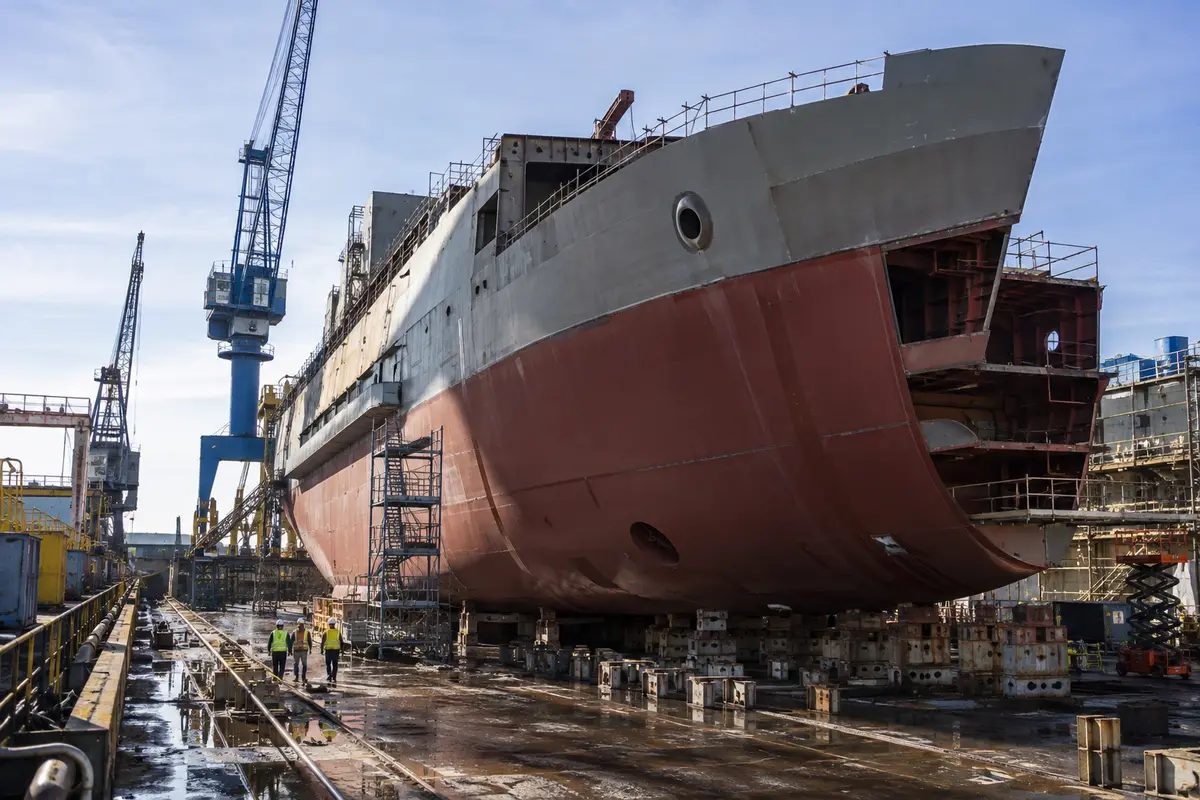
The skepticism worth naming is arithmetic, not politics. A more than thirteenfold capacity increase requires steelworkers, welders, pipefitters, electricians and supervisors in a labor market that has not produced them at scale for a generation. It requires supply chains for steel plate, engines and outfitting equipment that today largely terminate in Asia. And it requires an orderbook long enough to amortize the dry docks, because a dock that sits empty is a liability dressed as an asset. Each of those constraints is a multi-year program in itself, which is exactly why the pipeline — and not the announcement — is the story.
The State of Maine and the orderbook behind it
The christened vessel is the most visible evidence that the yard can finish what it starts. Hanwha described the NSMV State of Maine as a symbol of the bilateral partnership and vowed to make additional investments to ramp up capacity. As the third of five MARAD-ordered ships, it also implies a production line: sister vessels ahead of and behind it keep the workforce employed between commercial contracts, and continuity of work is the one ingredient a capacity ramp cannot improvise.

The mission profile extends the logic. A vessel that trains merchant mariners in peacetime and sails disaster-response and rescue missions in emergencies belongs to the category of assets a government must be able to build and maintain at home. If MASGA is to mean anything, it must mean that such ships can be delivered from American yards on schedule — and the State of Maine is the test case now floating in the Delaware River.
Three MRO contracts: the quiet proof of concept
While ceremonies attract cameras, the maintenance, repair and overhaul record is where trust is actually built. Hanwha Ocean earned a Master Ship Repair Agreement (MSRA) with the US Navy in July 2024, the qualification that allows a yard to compete for Navy maintenance work. Since then it has won three US Navy MRO contracts:
- USNS Wally Schirra — awarded in August 2024 and completed in March 2025 at the Geoje yard ahead of schedule;
- USNS Yukon — awarded in November 2024;
- USNS Charles Drew — awarded on July 8, 2025.
Three points deserve emphasis. First, the Wally Schirra job was finished early; in naval maintenance, schedule discipline is the scarcest commodity and the strongest recommendation letter a contractor can earn. Second, the contracts are sequential and partly overlapping, which is what turns a vendor into a pipeline: each award funds the teams and procedures that win the next one. Third, MRO work is the natural on-ramp for Philadelphia itself. Before a yard can build 20 ships a year, it must prove it can dock, open, repair and redeliver hulls to a navy's inspection standard — and the Navy's MRO queue is precisely where that proof is written.
It is also telling that all three contracts landed before or immediately after the Philadelphia acquisition closed: the repair qualification arrived in July 2024, almost simultaneously with the preparation of the yard purchase completed in December of the same year. In other words, Hanwha Ocean was building its relationship with the US Navy in parallel with its entry into the American industrial base, not after it. For an observer this detail matters: the maintenance track and the production track of MASGA advanced in step, each reinforcing the other.
Why the pipeline, not the headlines, decides MASGA's fate
Capacity is credibility
Headline deals — summits, signatures, announcements of billions — are cheap relative to dry docks. A dry dock is a decade-long commitment of concrete, steel and payroll that cannot be quietly walked back without visible loss. The $5 billion plan's two dry docks and three berths are therefore the most credible sentence in the entire MASGA story: they convert intention into assets that only make financial sense if the orderbook follows.
Maintenance work is the training ground
The MRO sequence — MSRA first, then Wally Schirra, Yukon and Charles Drew — is a curriculum. Every Navy repair teaches a yard US specifications, quality-assurance culture and documentation discipline, and it does so on someone else's hull long before a newbuild program depends on those skills. A shipyard that has never satisfied a US Navy supervisor cannot credibly promise 20 ships a year; one that has delivered ahead of schedule can.
Jobs make the politics durable
The presence of a governor and a senator at the christening is a reminder that MASGA's survival will be measured in payrolls. Kim Dong-kwan's emphasis on "good manufacturing jobs" and "a new skilled workforce right here in America" is the political economy of the program in one sentence: trade agreements change with administrations, but welding bays full of local workers create constituencies that defend them.
A customer in the White House
Finally, the demand side has a name and a quote. Trump's promise that the United States would buy Korean ships while rebuilding its own sector, capped by "We love their ships," ties MASGA to procurement rather than sentiment. A program with a stated customer can survive bad quarters; a program with only symbolism cannot.
What to watch next
- Ground-breaking and commissioning milestones for the two dry docks and three berths — the physical clock of the capacity ramp;
- Hiring and training programs in Philadelphia, including partnerships with trade unions and technical colleges to build the skilled workforce Kim Dong-kwan described;
- Follow-on US Navy MRO awards, and whether any of that work migrates from Geoje to the Delaware River;
- Conversion of the July 2025 trade deal's shipbuilding language into concrete orders for American-built hulls;
- Progress toward the interim target of 8–10 vessels a year by 2035, the checkpoint between today's 1.5 ships and the promised 20.
A wider alliance frame
Lee expressed hope that the initiative would open a new chapter in the alliance as a "future-oriented, comprehensive strategic partnership" encompassing security, economic and technological cooperation. The shipyard stop was the industrial coda of a six-day trip that included a visit to Japan for talks with Japanese Prime Minister Shigeru Ishiba; after the Philadelphia tour, Lee headed back to Seoul, concluding the journey. The sequencing is telling: security talks in Tokyo, trade talks in Washington, and a shipyard in between — because in 2025 the alliance's center of gravity has partly moved from deployment schedules to production schedules.
MASGA will not be judged by the applause at a christening. It will be judged by whether, a few years from now, the Delaware River yard docks hulls at a rhythm its current 1.5-ship-a-year self would not recognize, and whether the US Navy's maintenance queue shortens because a Korean-owned American yard absorbed part of it. The ceremony in Philadelphia was the promise; the pipeline of dry docks, berths, repair contracts and trained hands is the proof. That is why the unglamorous middle of this story — a repair agreement, three auxiliary ships, two docks under construction — deserves more attention than any single handshake in the Oval Office.












Leave a comment